Selecting the right valve for an industrial piping system is not simply a matter of matching the valve size to the pipe. The correct choice depends on what the valve needs to do, the media flowing through the line, operating pressure and temperature, flow conditions, material compatibility, connection type, shut-off requirements and maintenance needs.
This industrial valve selection guide explains the main valve selection criteria engineers, plant teams and industrial buyers should consider when choosing valves for water, steam, oil, gas, chemical and general process piping systems.
Quick selection principle: First define the valve function, then verify the media, pressure, temperature, flow conditions, materials, size, connection, actuation and maintenance requirements. The best valve is the one that satisfies the complete service condition rather than simply matching the nominal pipe size.
What Is Industrial Valve Selection?
Industrial valve selection is the process of choosing a valve design that can safely and reliably perform the required function under actual piping-system conditions.
Different valves are designed for different duties. A valve suitable for simple isolation may not be suitable for continuous throttling. A check valve intended to prevent reverse flow performs a completely different function from a safety valve designed for overpressure protection.
That is why proper valve selection starts with the application rather than with a particular valve type.
How to Select an Industrial Valve
If you are deciding how to select valves for a piping system, evaluate the following factors in sequence:
- Define the required function: isolation, throttling, regulation, backflow prevention, pressure protection or another duty.
- Identify the media: water, steam, oil, gas, air, chemical or another process fluid.
- Confirm pressure conditions: normal operating pressure, maximum pressure and design pressure.
- Confirm temperature: normal and maximum process temperature.
- Check flow conditions: required flow rate, velocity and acceptable pressure drop.
- Select compatible materials: valve body, trim, seat, seals and other wetted components.
- Confirm valve size and connection: threaded, flanged, wafer, socket-weld, butt-weld or another project-specified connection.
- Determine actuation: manual, pneumatic, electric or another control method.
- Check installation conditions: pipeline orientation, available space and access.
- Review maintenance requirements: inspection, isolation, spare parts and servicing access.
Industrial Valve Selection Criteria at a Glance
| Selection Factor | Question to Ask | Why It Matters |
|---|---|---|
| Function | What must the valve do? | Determines the suitable valve family. |
| Media | What fluid or gas is flowing? | Affects materials, seals and valve design. |
| Pressure | What are operating and design pressures? | Determines pressure rating and construction. |
| Temperature | What are normal and maximum temperatures? | Affects seats, seals, body and trim materials. |
| Flow | Is the duty isolation or flow control? | Affects valve geometry and pressure drop. |
| Material | Is the fluid corrosive or erosive? | Determines body and internal material suitability. |
| Connection | How will the valve connect to the pipeline? | Must match piping specification and installation. |
| Actuation | Manual or automated? | Affects operation, control and fail position. |
| Maintenance | Can the valve be inspected and serviced? | Influences lifecycle reliability and downtime. |
Choose the Valve by Required Function
The most important step in valve selection for piping systems is identifying the required function. Start with what the valve must accomplish before comparing individual products.
1. Isolation and Shut-Off
Isolation valves are used to start or stop flow through a pipeline or equipment section. Depending on the service, common options include ball valves, butterfly valves and gate valves.
A ball valve uses a rotating ball with a bore through the centre. Quarter-turn operation allows rapid opening and closing, and suitable designs can provide tight shut-off with relatively low flow resistance when fully open.
A butterfly valve uses a rotating disc mounted in the flow path. It is commonly considered for larger pipe sizes where compact dimensions, lower weight and simple quarter-turn operation are important.
If you are comparing these two isolation designs, review the butterfly valve vs ball valve selection guide.
2. Throttling and Manual Flow Adjustment
When a valve needs to regulate flow rather than operate only fully open or fully closed, the valve geometry becomes more important.
A globe valve is commonly used where controlled throttling is required. Its disc-and-seat arrangement creates a more defined restriction to flow than many simple isolation valves.
The main trade-off is that globe valves generally produce a higher pressure drop than full-port isolation valves. They should therefore be selected when their control capability justifies the additional flow resistance.
3. Automatic Process Regulation
A control valve responds to a process-control signal and changes its opening to regulate variables such as flow, pressure, temperature or liquid level.
Control-valve selection is more detailed than ordinary on-off valve selection because it requires process data such as minimum, normal and maximum flow, inlet and outlet pressure, pressure drop, flow characteristic, actuator requirement and fail position.
Read the technical guide on control valve working, parts, types and sizing inputs before preparing a control-valve enquiry.
4. Backflow Prevention
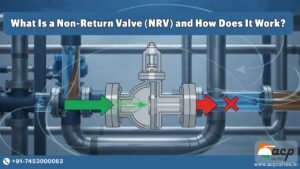
A non-return valve, also known as an NRV or check valve, allows flow in the intended direction and closes automatically when flow attempts to reverse.
It is commonly used after pumps, in utility pipelines, boiler-feed systems and process lines where reverse flow could damage equipment or disturb operation.
For detailed operation and selection information, see how a non-return valve works.
5. Pressure Protection
A safety valve is designed to protect pressure equipment and piping systems by opening automatically when pressure reaches its set condition.
Safety-valve selection requires confirmed set pressure, relieving capacity, media properties, temperature, back pressure, connection, material and applicable boiler or pressure-system requirements.
Safety valves should not be selected as ordinary throttling or process-control valves.
6. Pipeline Equipment Protection
A Y type strainer is not a shut-off valve, but it plays an important supporting role in many valve and piping installations. It removes dirt, scale, rust and other solid particles before they reach pumps, meters, steam traps, control valves and other sensitive downstream equipment.
See the Y type strainer working and installation guide for flow direction, screen selection and maintenance guidance.
Industrial Valve Types and Their Typical Functions
| Valve / Component | Primary Function | Typical Selection Context |
|---|---|---|
| Ball Valve | Isolation / shut-off | Quick quarter-turn operation and low flow resistance in suitable services |
| Butterfly Valve | Isolation / limited throttling | Large pipelines, compact installation and lower valve weight |
| Gate Valve | Isolation | Applications requiring a substantially unobstructed flow path when open |
| Globe Valve | Throttling / isolation | Manual flow regulation where pressure drop is acceptable |
| Control Valve | Automatic process regulation | Flow, pressure, temperature or level control |
| Non Return Valve | Backflow prevention | Pumps and piping systems requiring automatic reverse-flow protection |
| Safety Valve | Overpressure protection | Boilers, pressure equipment and protected process systems |
| Y Type Strainer | Filtration | Protection of valves and downstream equipment from solid debris |
Selecting a Valve According to the Process Media
Valve materials and sealing components must be compatible with the fluid or gas flowing through the pipeline.
Water Service
Water systems may use several valve designs depending on pressure, temperature, pipe size, required shut-off and water chemistry. Do not assume that all water applications have identical material requirements.
Steam Service
Steam valves must be evaluated for operating temperature, pressure, condensate conditions, body material, seats, packing and connection requirements. Steam service also requires attention to warm-up, drainage and safe isolation practices.
Oil and Hydrocarbon Service
Oil systems may require consideration of fluid viscosity, operating temperature, fire-safety requirements, leakage limits, elastomer compatibility and pressure class.
Gas and Compressed Air
Gas service requires careful consideration of leakage control, pressure, velocity, seat design, material compatibility and applicable piping specifications.
Chemical and Corrosive Media
Chemical service requires evaluation of the complete fluid composition, concentration, temperature and corrosion behaviour. A material that works with one chemical environment may be unsuitable for another.
Select Valve Materials Carefully
Body material is only one part of valve compatibility. The valve may also contain seats, discs, balls, stems, seals, gaskets, packing and other wetted components.
Common industrial materials include:
- Cast iron
- Ductile iron
- Carbon steel
- Cast steel
- Stainless steel
- Bronze
- Brass
- Application-specific alloy materials
For corrosive or hygienic applications, buyers often consider stainless steel construction. Review the stainless steel valve guide when comparing stainless valve options.
Pressure and Temperature Rating
A valve should not be selected only by its nominal pipe size. Check the pressure-temperature rating applicable to the valve material, design and connection.
Provide both normal operating conditions and maximum design conditions when preparing an enquiry.
- Operating pressure
- Design or maximum pressure
- Operating temperature
- Maximum design temperature
- Possible pressure surges
- Vacuum conditions, where applicable
Pressure ratings can change with temperature, so a nominal pressure designation should not be interpreted without the applicable product data.
Consider Flow Rate and Pressure Drop
Different valve designs create different levels of resistance to flow.
A full-port ball valve can provide relatively low resistance when fully open, while a globe valve intentionally changes the flow direction and normally produces greater pressure loss.
For basic isolation duty this may not be critical, but pressure drop becomes important in high-flow pipelines, pump systems and process-control applications.
Valve Size Does Not Always Equal Pipe Size
Many isolation valves are selected at the nominal pipe size, but this should not be treated as an automatic rule for every application.
Control valves, for example, are commonly sized according to required flow capacity and available pressure drop. An incorrectly oversized control valve can operate near its closed position and produce unstable control, while an undersized valve may not provide the required capacity.
Select the Correct End Connection
The connection must match the piping-system specification and service requirements.
| Connection | Typical Consideration |
|---|---|
| Threaded | Compact connection used in suitable smaller-size piping systems |
| Flanged | Common industrial connection that supports assembly and maintenance |
| Wafer | Compact butterfly-valve installation between pipeline flanges |
| Lug | Butterfly-valve connection with body lugs around the flange area |
| Socket Weld | Welded connection used in suitable small-bore applications |
| Butt Weld | Permanent welded connection used in many process piping systems |
Manual vs Automated Valve Selection
Not every valve needs an actuator. Manual operation may be appropriate where switching frequency is low and the valve is easily accessible.
Automated operation may be considered when the process requires:
- Remote operation
- Frequent cycling
- Process-control integration
- Emergency shutdown
- Defined fail-open or fail-closed behaviour
- Operation in difficult or hazardous locations
Actuator selection should consider required torque or thrust, available utility supply, operating speed, environmental conditions and control-system requirements.
Valve Selection by Application
| Application Need | Valve Type Commonly Considered |
|---|---|
| Quick isolation | Ball valve |
| Large-diameter compact isolation | Butterfly valve |
| Manual throttling | Globe valve |
| Automatic flow regulation | Control valve |
| Reverse-flow protection | Non-return / check valve |
| Overpressure protection | Safety valve |
| Debris filtration before equipment | Y type strainer |
Important: This table provides a starting point, not a substitute for application-specific engineering review.
Common Industrial Valve Selection Mistakes
- Selecting a valve only because it matches the pipe diameter.
- Using an isolation valve for continuous throttling without checking suitability.
- Ignoring maximum temperature or pressure.
- Choosing body material without checking seats, seals and trim.
- Ignoring flow direction on directional valves or strainers.
- Using an incorrect end connection or pressure class.
- Oversizing a control valve.
- Ignoring maintenance clearance.
- Choosing solely by purchase price.
- Not providing complete process data to the manufacturer or supplier.
Industrial Valve Selection Checklist
Before requesting a quotation, prepare the following information:
- Valve function: isolation, throttling, control, check or pressure protection.
- Valve type: ball, butterfly, globe, gate, NRV, safety valve or another required type.
- Media: water, steam, oil, air, gas, chemical or process fluid.
- Size: required nominal pipeline size.
- Pressure: normal and maximum/design pressure.
- Temperature: operating and design temperature.
- Material: required body, trim, seat and seal materials where specified.
- Connection: threaded, flanged, wafer, lug or welded.
- Flow requirement: especially for throttling or control applications.
- Actuation: manual, pneumatic or electric.
- Quantity: required number of valves.
- Documentation: certificates, inspection or project-specific requirements.
For a more accurate valve quotation: Send ACP Valves the service media, valve function, size, working pressure, temperature, connection, required material, quantity and any project-specific technical or documentation requirements.
Why Maintenance Should Be Considered During Valve Selection
A technically suitable valve can still create operational problems if it cannot be safely inspected, removed or maintained after installation.
Before final selection, consider:
- Access to the valve body and bonnet
- Space for actuator removal
- Seat and seal replacement
- Pipeline isolation requirements
- Availability of spare parts
- Cleaning requirements
- Expected operating cycles
- Inspection and testing procedures
Industrial Valve Selection for Complete Piping Systems
A piping system normally uses more than one valve type because different sections perform different functions.
For example, a pump system may include an isolation valve before or after the pump, a non-return valve to prevent reverse flow, a control valve where flow regulation is required and a strainer where debris protection is necessary.
This is why a good industrial valve selection guide should be used as a system-level reference rather than treating every valve as an independent component.
FAQs About Industrial Valve Selection
How do I select the right industrial valve?
Start by defining the required function, then confirm the process media, pressure, temperature, flow rate, valve size, materials, connection, actuation, installation orientation and maintenance requirements.
What are the main industrial valve selection criteria?
The main criteria are valve function, media, operating and design pressure, temperature, flow conditions, material compatibility, size, pressure class, end connection, actuation and maintenance requirements.
Which valve is best for isolation?
Ball valves, butterfly valves and gate valves are commonly used for isolation, but the correct design depends on pipe size, media, pressure, temperature, shut-off requirement, operating frequency and available installation space.
Which valve is used for throttling?
Globe valves are commonly used for manual throttling because their flow path allows controlled adjustment. Control valves are used where automatic process regulation is required.
What valve prevents reverse flow?
A non-return valve, check valve or NRV allows flow in the intended direction and closes automatically when reverse flow develops.
What valve protects against overpressure?
A safety valve or applicable pressure-relief device is used to protect pressure equipment and piping systems from excessive pressure.
Why is media important when selecting a valve?
The media affects corrosion resistance, seal compatibility, material selection, erosion behaviour and safety requirements. The complete fluid composition and operating conditions should therefore be considered.
Can valve size be selected only from pipe size?
No. Pipe size is important, but some applications—especially control-valve service—also require flow-capacity and pressure-drop calculations.
Should valve selection consider maintenance?
Yes. Access, inspection requirements, spare parts, cleaning, seat and seal replacement and safe pipeline isolation can all affect lifecycle performance.
Conclusion
Correct industrial valve selection begins with understanding the required function and actual operating conditions. Pipe size alone is not enough.
Evaluate the media, pressure, temperature, flow conditions, materials, connection, actuation, installation and maintenance requirements before choosing between ball valves, butterfly valves, globe valves, control valves, non-return valves, safety valves and other industrial valve designs.
Use this industrial valve selection guide as the central reference for choosing the correct valve family, then review the detailed ACP technical guides for the specific valve type required by your application.
For application-based valve selection, review the ACP Valves product range or contact ACP Valves with your media, size, pressure, temperature, material, connection and service requirements.