
Urgent Call?
+91-7453000063
Email Us
sales@acpvalves.in
+91-7453000063
sales@acpvalves.in
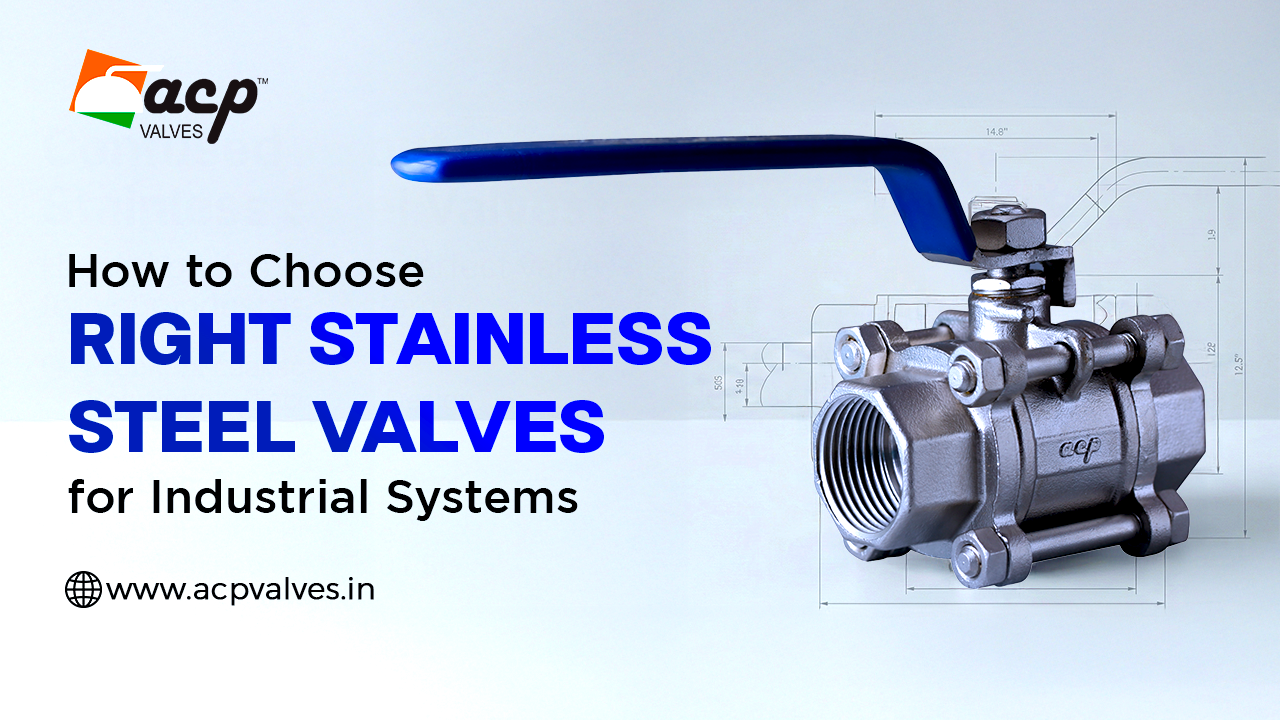
Stainless steel valves are widely used in industrial piping systems where corrosion resistance, cleanliness and dependable operation are important. They are available in different designs and material grades, so choosing the right valve involves more than simply asking for a “stainless steel valve.”
The correct choice depends on what the valve needs to do, the fluid passing through the system, operating pressure and temperature, material grade, connection type and project requirements. This guide explains the main stainless steel valve types, commonly used grades such as SS304, SS316, CF8 and CF8M, typical applications and the practical checks buyers should make before selection.
Stainless steel valves are flow-control components manufactured with stainless steel as an important part of their construction. Depending on the valve design, they may be used to isolate flow, regulate flow, prevent reverse flow or protect a piping system from excessive pressure.
Common examples include ball valves, globe valves, butterfly valves, non return valves and safety valves. The valve type determines its function, while the stainless steel grade helps determine whether the material is suitable for the operating environment.
For industrial buyers, these two decisions should always be considered together. A suitable valve design in the wrong material can be just as problematic as choosing the right material for the wrong valve function.
One of the main reasons stainless steel is used in industrial valve construction is its resistance to corrosion in suitable service conditions. It is therefore considered for many water, chemical, food-processing, pharmaceutical, utility, steam and process applications.
Stainless steel valves may also be selected where cleanliness, material durability or resistance to the surrounding environment is important. However, stainless steel should not be treated as one universal material. Different grades can behave differently depending on the fluid, concentration, pressure, temperature and operating environment.
This is why the material grade should always be confirmed as part of the valve specification rather than relying only on the term “stainless steel.”
Different valve designs perform different jobs within a piping system. Stainless steel is available across several common industrial valve categories.
Ball valves are commonly used where reliable shut-off and relatively quick operation are required. Stainless steel ball valves may be considered for suitable industrial, water and process applications where the selected material grade is compatible with the service conditions.
For manufacturer and procurement-related information, see our ball valve manufacturers in India guide.
Globe valves are commonly associated with isolation and throttling duties. Stainless steel construction may be selected where the process conditions require suitable corrosion resistance together with controlled flow operation.
You can also review our globe valve manufacturers in India guide for broader sourcing considerations.
Non return valves, also known as NRVs or check valves, are designed to allow flow in one direction and help prevent reverse flow. Stainless steel construction can be useful where the valve material needs to suit corrosive or demanding service conditions.
For working principle and selection basics, see our Non Return Valve (NRV) guide.
Butterfly valves are compact flow-control valves commonly used in larger piping systems and utility applications. Depending on the design, stainless steel may be used for the body, disc or other components.
If you are comparing valve technologies, our butterfly valve vs ball valve guide explains the main differences.
Safety valves are used to help protect pressure systems by relieving excess pressure under specified conditions. Material selection is especially important because the valve must suit the pressure, temperature, fluid and applicable project requirements.
For sourcing considerations, see our safety valve manufacturers in India guide.
Although a strainer is not technically a valve, Y-type strainers are frequently used alongside valves in industrial piping systems. Stainless steel versions may be selected where material compatibility and corrosion resistance are important.
Read our Y-Type Strainer guide for more detail.
The performance of industrial stainless steel valves depends heavily on the selected material grade. Material choice should be based on the fluid, concentration, pressure, temperature, surrounding environment and project specification.
| Grade | General Use | Selection Consideration |
|---|---|---|
| SS304 | Common general industrial service | Check compatibility with the actual process media and environment |
| SS316 | Applications requiring greater corrosion resistance in suitable environments | Often considered where service conditions are more demanding |
| CF8 | Common cast stainless steel valve components | Verify the required cast material specification for the project |
| CF8M | Cast stainless steel used for more demanding corrosion conditions in suitable applications | Confirm media, temperature, pressure and project specification |
There is no single stainless steel grade that is automatically best for every valve. The material should be selected according to the actual operating conditions rather than simply choosing the highest grade available.
SS304 and SS316 are two commonly considered stainless steel grades in industrial valve applications. SS304 can be suitable for many general-service conditions, while SS316 may be preferred where additional corrosion resistance is required.
That does not mean SS316 is automatically necessary for every project. The more useful question is whether the material is compatible with the actual fluid and operating environment.
Before choosing between SS304 and SS316, consider:
If the project already specifies a particular stainless steel grade, the valve should be quoted against that requirement rather than substituting another grade without technical review.
CF8 and CF8M are commonly used cast stainless steel grades for valve bodies and related components. In practical valve selection, CF8 may be considered for suitable general service, while CF8M may be selected where the application requires greater resistance to more demanding corrosive conditions.
The material designation alone is not enough to determine suitability. Buyers should still check the process media, temperature, pressure, required standards and project documentation before finalizing the valve.
Stainless steel valves are used across many industrial sectors, but the exact valve design and material grade depend on the service conditions.
| Application | Why Stainless Steel May Be Considered |
|---|---|
| Chemical and process systems | Material compatibility and corrosion resistance can be important |
| Food and beverage systems | Cleanliness and suitable material construction may be required |
| Pharmaceutical applications | Material quality and process cleanliness can influence selection |
| Water treatment | Corrosion resistance may be useful depending on water quality and treatment chemicals |
| Steam and utility systems | Pressure, temperature and material compatibility must be checked carefully |
| Oil and gas applications | Material selection depends on service severity and project specifications |
| Marine environments | External and internal corrosion conditions can influence material choice |
| General industrial pipelines | Stainless steel may be selected where durability and corrosion resistance are required |
These are general application areas rather than automatic recommendations. The valve design and material grade should always be matched to the actual duty.
A common mistake is to select a stainless steel grade first and assume the valve will then be suitable for the application. In reality, the complete valve design must also be checked against the required pressure and temperature.
The acceptable limits of a valve can depend on its body design, pressure rating, seat, seals, trim, end connection and other components. A stainless steel body alone does not determine the full operating capability of the valve.
Always compare the manufacturer’s technical data with the project’s normal and maximum operating conditions before final selection.
A practical selection process starts with the application rather than the valve catalogue. Before asking for a quotation, define what the valve needs to do and the conditions under which it will operate.
This approach makes quotations easier to compare because manufacturers and suppliers are working from the same basic specification.
A clear request for quotation reduces unnecessary back-and-forth and helps prevent different suppliers from quoting technically different valves under the same description.
Where applicable, include the following information:
For a broader overview of ACP’s available valve and pipeline products, you can review the ACP Valves product range.
Stainless steel can provide good durability in suitable applications, but the valve still requires normal inspection and maintenance. Operating conditions, media deposits, seat wear, seals, corrosion, actuator condition and installation issues can all affect performance over time.
A practical maintenance programme may include visual inspection, leakage checks, operation checks, cleaning where necessary and replacement of worn components according to the valve design and service conditions.
Maintenance intervals should be based on the application, operating frequency and manufacturer’s recommendations rather than assuming every stainless steel valve requires the same schedule.
Several purchasing mistakes can be avoided by preparing a complete specification before comparing quotations.
Taking a few extra minutes to confirm these points at the enquiry stage can make valve selection considerably more straightforward.
Stainless steel valves are used to isolate or control flow, prevent reverse flow and protect piping systems in suitable industrial applications. Common uses include water, chemical, food-processing, pharmaceutical, utility and process systems.
Common types include ball valves, globe valves, butterfly valves, non return valves and safety valves. The right type depends on whether the system requires shut-off, throttling, backflow prevention, pressure protection or another function.
There is no single grade that is best for every application. SS304 and CF8 may be considered for suitable general service, while SS316 and CF8M may be preferred for more demanding corrosive environments. The final choice depends on the process media, pressure, temperature and project specification.
Not necessarily. SS316 may offer advantages in certain corrosive environments, but SS304 can still be suitable for many applications. Material selection should be based on actual service conditions rather than simply choosing the higher grade.
Provide the valve type, media, size, pressure, temperature, stainless steel grade, end connection, seat or seal requirement, operating method, quantity and any testing or certification requirements.
Compare suppliers on technical compliance first. Confirm the proposed valve type, stainless steel grade, pressure rating, materials, testing, documentation and suitability for the application before comparing price and delivery.
Choosing stainless steel valves is not simply a matter of selecting a valve made from stainless steel. The valve type, material grade, process media, pressure, temperature, connection, seats and seals all need to work together for the intended application.
SS304, SS316, CF8 and CF8M are commonly used grades, but none is automatically correct for every service. A better approach is to define the operating conditions first and then select the valve design and material that meet those requirements.
For an ACP-specific requirement, review the ACP product range or contact ACP Valves with your valve type, media, pressure, temperature, material grade and project requirements.
Copyright © 2022. All rights reserved.ACP VALVES
Crafted With ❤️ By Digicircal – Web Designing, Digital Marketing & Branding Company