
Urgent Call?
+91-7453000063
Email Us
sales@acpvalves.in
+91-7453000063
sales@acpvalves.in
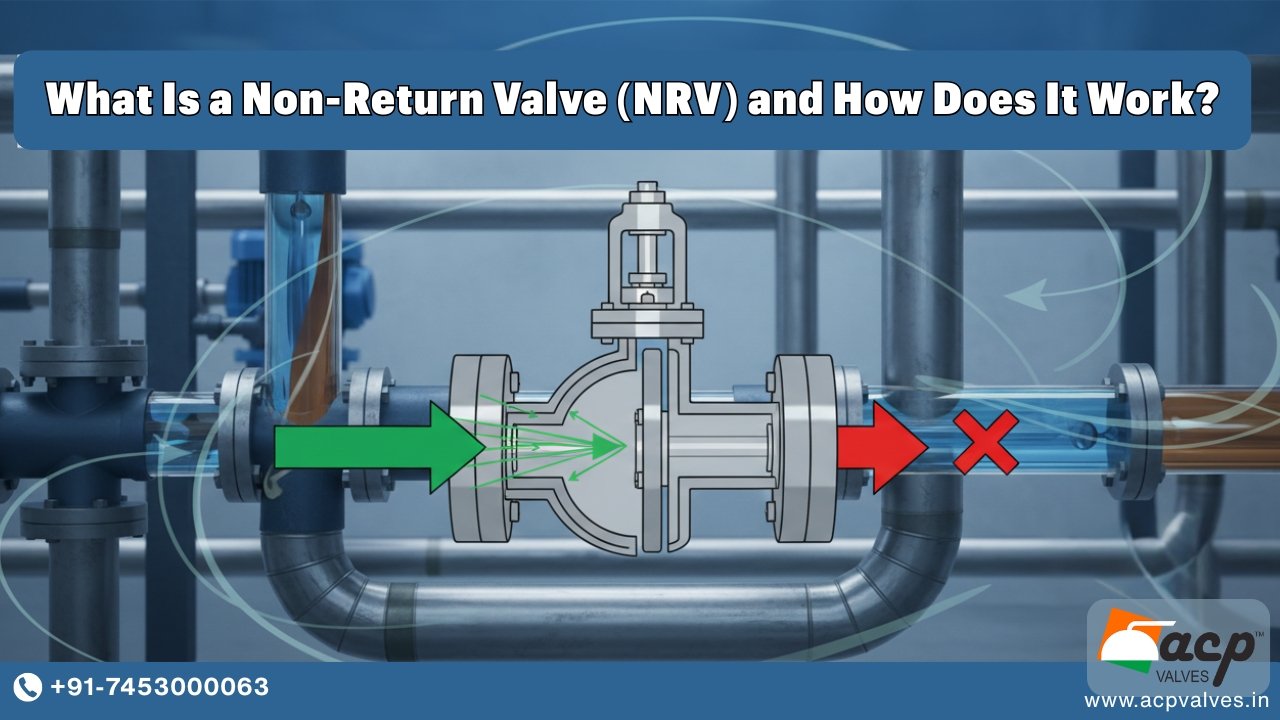
A non return valve (NRV) is an automatic one-way valve that allows fluid to move in the intended direction while helping prevent reverse flow or backflow. It is also commonly known as a check valve.
NRV stands for Non Return Valve. These valves are widely used in pump discharge lines, water systems, steam and condensate pipelines, HVAC systems and industrial piping where reverse flow could affect equipment or process performance.
This guide explains how a non return valve works, the correct flow direction, common applications and the main factors to consider when selecting an NRV for an industrial piping system.
A non return valve (NRV) is designed to permit fluid to flow through a pipeline in one direction while restricting unwanted flow in the opposite direction.
Unlike an isolation valve that normally requires manual or actuated operation, an NRV usually opens and closes automatically according to pressure and flow conditions.
| Point | Explanation |
|---|---|
| Full form | NRV stands for Non Return Valve |
| Other common name | Check valve |
| Main function | Allow forward flow while restricting reverse flow |
| Operation | Normally automatic |
| Closing mechanism | May use a disc, plate, piston, ball or spring-assisted mechanism depending on valve design |
The internal construction can vary between different NRVs, but their basic function remains the same: permit flow in the required direction and restrict unwanted backflow when operating conditions change.
The non return valve working principle is mainly based on differential pressure between the inlet and outlet sides of the valve.
When upstream pressure creates enough force in the intended flow direction, the internal closing element moves away from its seat and fluid passes through the valve.
As forward flow decreases or reverse pressure starts to develop, gravity, spring force, reverse pressure or a combination of these forces moves the closing element back toward its seat. Once the valve closes, it restricts the fluid from travelling backward through the pipeline.
Cracking pressure is the minimum differential pressure required to start opening an NRV.
It should not be confused with the pressure required to keep the valve completely open. Actual opening behaviour depends on valve construction, spring force, fluid characteristics, flow rate and operating conditions.
Cracking pressure can be especially important in low-pressure systems and spring-assisted check valves because an unsuitable opening pressure may restrict the required system flow.
A non return valve must be installed according to the intended direction of flow. Industrial NRVs normally have a flow arrow marked, cast or stamped on the valve body.
Typical flow arrangement:
Upstream / Pump → NRV → Downstream Pipeline
The arrow should point toward the side to which the fluid is intended to travel.
Installing the valve backwards may restrict normal flow or prevent correct operation. Mounting orientation should also be checked because some designs can operate in both horizontal and vertical pipelines while others have specific installation requirements.
Always confirm the approved installation direction and mounting position for the actual valve being used.
Non return valves are available with different internal closing mechanisms. The design should be treated as part of the selection process rather than chosen only by valve name.
| NRV Design | Main Selection Consideration |
|---|---|
| Swing check | Flow conditions, orientation and closing behaviour |
| Lift check | Pressure drop and fluid cleanliness |
| Piston check | Operating conditions and guided closure movement |
| Spring-loaded check | Cracking pressure and closing response |
| Dual-plate check | Compact installation and closing behaviour |
| Wafer check | Installation space and flange compatibility |
| Ball check | Media characteristics and installation orientation |
The appropriate design depends on the fluid, expected flow rate, operating pressure, available differential pressure, installation orientation, acceptable pressure loss and required closing response.
In normal industrial terminology, non return valve and check valve generally describe the same broad category of automatic one-way valves.
Different industries and specifications may prefer one term over the other. During valve selection, the more important considerations are the actual construction, body material, pressure rating, connection type, operating conditions and suitability for the intended service.
A non return valve is used where reverse flow could affect equipment, system performance, process conditions or another part of a piping network.
A non return valve (NRV) is commonly installed on the discharge side of a pump to help prevent the pumped fluid from returning when the pump stops, trips or loses discharge pressure.
Depending on the system design, uncontrolled reverse flow may contribute to reverse pump rotation, pressure disturbances, loss of prime or additional mechanical stress.
NRV selection for a pump system should therefore consider the actual operating flow and system behaviour rather than connection size alone.
In water systems, an NRV may be used wherever water needs to continue in one intended direction without freely returning through the same pipeline.
Typical examples include booster-pump arrangements, distribution pipelines, storage systems and water-pump discharge lines.
Selecting the right NRV requires more than matching the valve size to the pipe diameter. Engineers, buyers, contractors and maintenance teams should consider the actual operating conditions of the system.
The main factors include media, flow rate, operating pressure, temperature, material compatibility, end connection, installation orientation, cracking pressure and required closing response.
| Selection Factor | What Should Be Checked |
|---|---|
| Fluid / Media | Water, steam, condensate, oil, gas or process media |
| Operating Pressure | Normal and maximum system pressure |
| Temperature | Minimum, normal and maximum service temperature |
| Flow Rate | Minimum, normal and maximum expected flow |
| Valve Size | Suitability for actual operating flow rather than pipeline size alone |
| Materials | Body, trim, seat, seal and spring compatibility with the media |
| Installation Orientation | Horizontal, vertical or another approved mounting position |
| Cracking Pressure | Differential pressure required to begin opening |
| Pressure Drop | Acceptable hydraulic loss across the valve |
| Closing Response | Potential for reverse velocity, surge or valve slam |
| End Connection | Flanged, threaded, wafer or another required connection |
| Project Requirements | Applicable design, material, testing and documentation requirements |
An oversized NRV may operate only partly open when normal flow is too low. This can contribute to unstable closure movement, vibration, chatter, additional wear or inefficient operation.
An undersized valve may create excessive pressure drop or unnecessarily high flow velocity.
The selected valve should therefore operate appropriately across the expected flow range rather than being chosen only because its nominal size matches the pipeline diameter.
For broader information about selecting valves according to system requirements, see the industrial valve selection guide.
Review ACP non return valve options
Check the available valve range, then share your size, quantity and application requirement.
Correct installation is important because even a properly selected non return valve may perform poorly if it is installed in the wrong direction or under unsuitable piping conditions.
Some NRV designs can be installed vertically, but vertical installation should not be assumed to be suitable for every valve.
The direction of flow, valve construction, effect of gravity and approved mounting position should all be checked before installation.
Problems with non return valves are often related to operating conditions, incorrect sizing, debris, wear or installation conditions rather than the valve body alone.
| Problem | Possible Cause | What to Check |
|---|---|---|
| Reverse leakage | Debris or damaged sealing surfaces | Inspect the seat and closing element after safe isolation |
| Chattering | Low or unstable flow, oversizing or partial opening | Check actual operating flow and valve sizing |
| Valve slam | Reverse velocity develops before closure | Review system behaviour and closing response |
| Valve will not open | Insufficient differential pressure | Check cracking pressure and flow direction |
| High pressure drop | Incorrect sizing, obstruction or restricted opening | Review sizing and inspect the flow path |
Safety note: internal inspection should only be carried out after the relevant pipeline has been properly isolated and depressurised according to approved site procedures.
Industrial check valves may be specified according to different standards depending on valve construction, pressure class, dimensions, materials, connections and project requirements.
For example, API 594 covers specified check-valve designs, while API 598 addresses valve inspection and testing within its applicable scope.
A valve should not be assumed to comply with a particular standard simply because it performs a non-return function. The required design standard, testing requirement, material specification, pressure class and documentation should be confirmed for the actual product and project.
A non return valve is an automatic one-way valve that permits fluid to flow in the intended direction while restricting reverse flow. It is also commonly known as a check valve.
NRV stands for Non Return Valve. The term is commonly used in pump systems, water pipelines, steam systems, HVAC and industrial piping.
An NRV opens when sufficient forward differential pressure moves the internal closing element away from its seat. When forward flow decreases or reverse pressure develops, the closing element returns toward its seat and restricts backflow.
An NRV is commonly installed on the discharge side of a pump so fluid cannot freely return through the pump when discharge pressure falls. The exact location should follow the system design and applicable equipment recommendations.
Check the media, expected flow rate, operating pressure, temperature, material, connection type, mounting orientation, cracking pressure and required closing response. These operating details should be considered before selecting an industrial NRV.
Some NRVs are suitable for vertical installation, but suitability depends on valve construction, direction of flow and the approved mounting position. The product requirements should be confirmed before installation.
A properly selected non return valve (NRV) helps maintain one-directional flow and reduce unwanted reverse flow in a piping system. Reliable operation depends on matching the valve with the actual media, pressure, temperature, flow rate, connection, installation orientation and system conditions.
If you are selecting an NRV for a new project, replacement or industrial piping requirement, review the available ACP Valves product range and prepare the basic application details before sending your enquiry.
Have an NRV requirement?
Share your required size, quantity, media, pressure and application details with ACP Valves.

Copyright © 2022. All rights reserved.ACP VALVES
Crafted With ❤️ By Digicircal – Web Designing, Digital Marketing & Branding Company