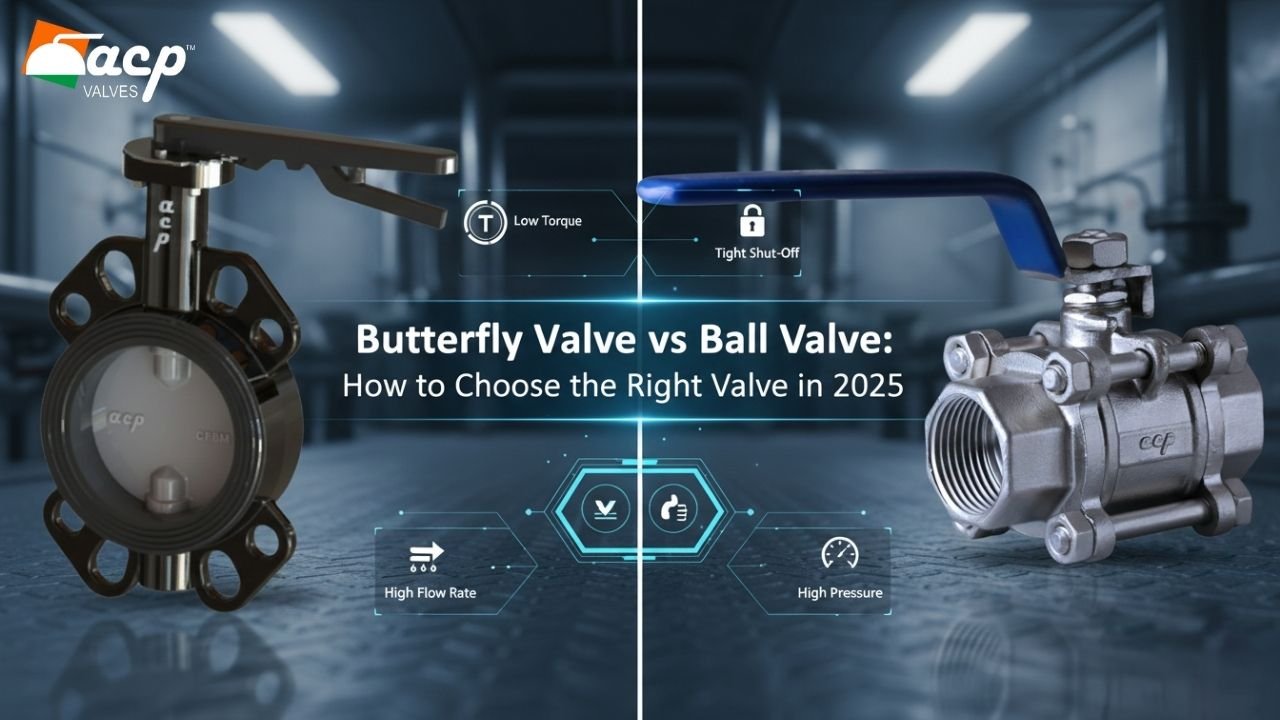
Choosing between a butterfly valve and a ball valve isn’t simply a matter of selecting the cheaper option. The correct valve depends on pipeline size, operating pressure and temperature, process media, shut-off requirements, pressure-drop limits, installation space and how the valve will be operated.
Both are quarter-turn valves widely used in industrial piping, but their internal designs create important differences in flow characteristics, sealing, size, weight, cost and application suitability. Understanding the butterfly valve vs ball valve comparison helps engineers and buyers avoid oversizing, poor flow performance and unnecessary project cost.
Quick answer: A ball valve is generally preferred when tight shut-off, low pressure drop and full-bore flow are important. A butterfly valve is generally preferred for larger pipelines where compact size, lower weight and economical isolation or basic throttling are priorities. Neither valve is universally better—the correct choice depends on the service conditions.
Butterfly Valve vs Ball Valve: Quick Comparison
| Comparison Point | Ball Valve | Butterfly Valve |
|---|---|---|
| Closing element | Rotating ball with bore | Rotating disc |
| Primary use | On-off isolation | Isolation and basic throttling |
| Shut-off | Generally better for tight shut-off | Depends strongly on seat and valve design |
| Pressure drop | Very low with full-bore design | Usually higher because the disc remains in the flow path |
| Large pipe sizes | Can become heavy and expensive | Usually more compact and economical |
| Installation space | Requires more body space | Compact and lightweight |
| Flow regulation | Mainly on-off service | More suitable for basic throttling |
| Operation | Quarter-turn | Quarter-turn |
This table gives the basic difference between butterfly valve and ball valve, but actual valve selection should always consider the manufacturer’s design, seat material, pressure rating, temperature rating and process conditions.
What Is a Ball Valve?
A ball valve controls flow with a spherical closing element containing a bore. When the bore is aligned with the pipeline, fluid passes through the valve. Rotating the ball by 90 degrees moves the solid portion of the ball across the flow path and closes the valve.
Ball valves are widely used because they provide fast quarter-turn operation, reliable isolation and low resistance to flow when fully open. Full-port or full-bore designs can provide a flow passage close to the internal diameter of the connected pipeline.
Typical applications include water, oil, gas, compressed air, utility services and compatible process fluids. However, body, ball, seat and seal materials must always be selected according to the actual service.
What Is a Butterfly Valve?
A butterfly valve controls fluid using a disc mounted on a shaft inside the valve body. Rotating the disc approximately 90 degrees changes the valve from fully open to closed.
Because the disc remains inside the pipeline, the design is extremely compact compared with many other isolation valves. This is one reason butterfly valves become especially attractive as pipeline diameter increases.
Butterfly valves are commonly used in water treatment, HVAC systems, cooling-water circuits, fire-protection systems, utilities and industrial process pipelines where compact size and economical large-diameter isolation are important.
Butterfly Valve vs Ball Valve: Main Differences
The main butterfly valve and ball valve difference is the closing mechanism. A ball valve uses a rotating spherical ball, while a butterfly valve uses a rotating disc positioned in the flow path. That design difference affects sealing, pressure drop, installation size, weight, cost and suitability for different pipe diameters.
1. Shut-Off Performance
Ball valves are commonly selected for applications requiring dependable isolation and tight shut-off. The ball and seat arrangement can provide excellent sealing when correctly specified.
Butterfly-valve sealing depends on the seat, disc geometry and valve design. Modern resilient-seated and high-performance butterfly valves can provide strong shut-off performance, but the required leakage class should always be confirmed rather than assumed.
2. Pressure Drop
A full-bore ball valve provides a relatively unobstructed flow path when completely open, which can result in very low pressure loss.
In a butterfly valve, the disc remains in the flow stream even when fully open. This creates additional flow resistance compared with many full-port ball-valve designs.
3. Pipeline Size and Weight
As valve diameter increases, ball valves generally become larger, heavier and more expensive. Butterfly valves have a thinner body and fewer bulky internal components, which often makes them more practical for medium and large pipelines.
4. Flow Control
Standard ball valves are mainly intended for fully open or fully closed service. Holding some designs partially open for long periods can increase velocity through the restricted area and may damage seats or other components depending on the service.
Butterfly valves are often more suitable for basic flow regulation because disc position can be varied through the operating range. For accurate process control, however, a properly sized control valve may be more appropriate.
For precision regulation requirements, review ACP’s control valve guide.
5. Installation Space
Butterfly valves are especially useful where space and equipment weight are restricted. Wafer and lug-type designs can fit between pipeline flanges with comparatively little longitudinal space.
Ball valves require more body volume, particularly at larger sizes, although they remain highly practical for small and medium pipelines.
6. Cost
There is no universal price rule because valve material, size, pressure class, end connection, seat design and actuation all affect cost. However, butterfly valves often become more economical than ball valves as pipe diameter increases.
Butterfly Valve vs Ball Valve: Which Is Better?
Neither valve is better for every application. The right answer depends on what the piping system needs to achieve.
| Application Requirement | Usually Preferred | Reason |
|---|---|---|
| Tight shut-off | Ball valve | Strong sealing performance in many on-off services |
| Large-diameter pipeline | Butterfly valve | Compact, lightweight and often more economical |
| Very low pressure drop | Ball valve | Full-bore designs provide a relatively open flow path |
| Limited installation space | Butterfly valve | Thin body requires less pipeline space |
| Quick quarter-turn isolation | Both | Both designs can provide quarter-turn operation |
| Basic throttling | Butterfly valve | Disc position allows basic regulation |
| Precise process regulation | Control valve | Dedicated control-valve designs provide better controllability |
If your requirement is supplier-specific rather than a design comparison, see ACP’s separate guides to ball valve manufacturers in India and butterfly valve manufacturers in India.
When Should You Choose a Ball Valve?
A ball valve is generally a strong option when reliable isolation, quick operation and low flow resistance are priorities.
- Tight shut-off is important
- The pipeline is small to medium in diameter
- Very low pressure drop is preferred
- The valve will operate mainly fully open or fully closed
- A full-bore flow path is required
- The service conditions are compatible with the selected body, ball and seat materials
For procurement research, see ACP’s guide to top ball valve manufacturers in India.
When Should You Choose a Butterfly Valve?
A butterfly valve is generally attractive when pipeline diameter, weight, available installation space and project cost are important considerations.
- The pipeline is medium or large in diameter
- Compact installation is required
- Valve weight needs to be reduced
- An economical solution is required for larger pipelines
- Manual, gear, pneumatic or electric operation is needed
- Basic throttling is required in addition to isolation
For supplier research, read ACP’s butterfly valve manufacturers in India guide.
Ball Valve vs Butterfly Valve by Application
The ball valve vs butterfly valve decision becomes easier when the valve is matched to actual process conditions instead of being selected only by size or price.
| Application | Typical Preference | Important Check |
|---|---|---|
| Water distribution | Either | Size, pressure, actuation and shut-off requirement |
| Large cooling-water line | Butterfly valve | Disc/seat material and operating torque |
| Oil or gas isolation | Ball valve may be preferred | Pressure class, fire-safe requirement and sealing |
| HVAC pipeline | Butterfly valve | Flow requirement, size and actuation |
| Low-pressure large-diameter utility line | Butterfly valve | Seat compatibility and pressure rating |
| Full-bore process line | Ball valve | Bore design and pressure-temperature rating |
| Accurate throttling | Dedicated control valve | Required Cv, rangeability and control accuracy |
7 Factors to Check Before Selecting Either Valve
1. Pipeline Size
Valve diameter strongly affects weight, dimensions and cost. Large-diameter applications often favour butterfly valves, while ball valves remain common in smaller and medium sizes.
2. Pressure and Temperature
Check the manufacturer’s pressure-temperature rating rather than relying only on nominal pressure class. Seat and seal limits can be as important as body strength.
3. Process Media
Confirm compatibility of the valve body, trim, seat, seals and other wetted parts with the actual liquid, gas or steam service.
4. Required Shut-Off
Define the acceptable leakage requirement. Do not assume that every valve advertised as an isolation valve provides the same sealing performance.
5. Pressure Drop
If minimizing flow resistance is important, compare valve bore geometry and the manufacturer’s flow coefficient or pressure-loss data.
6. Operating Method
Determine whether the valve requires a lever, gearbox, pneumatic actuator or electric actuator. Valve torque, operating frequency and fail position should be considered in automated systems.
7. Maintenance and Accessibility
Consider seat replacement, actuator access, pipeline shutdown requirements and whether the surrounding installation provides enough maintenance clearance.
Pressure Drop and Flow Performance
A ball valve normally provides lower pressure drop when a full-bore valve is completely open because fluid can travel through a relatively straight flow path.
A butterfly valve keeps its disc inside the flow stream. This adds some resistance, but its compact construction may still make it the better engineering and commercial choice for many large pipelines.
Cost and Maintenance Difference
For smaller pipe sizes, ball valves are commonly selected because they combine simple quarter-turn operation with reliable shut-off. As diameter increases, the size, weight and cost of a ball valve can rise considerably, while a butterfly valve normally remains more compact.
Maintenance requirements depend on the individual design and operating conditions. Ball-valve maintenance can involve seats, stem seals and ball surfaces. Butterfly-valve maintenance can involve the seat, disc, shaft, seals, gearbox or actuator.
The lowest purchase price should therefore not be the only decision factor. Lifecycle accessibility, spare parts, actuation and process compatibility also matter.
Material and Media Compatibility
The correct valve material depends on fluid chemistry, operating temperature, pressure and corrosion conditions. Stainless steel is commonly considered where corrosion resistance, cleanliness or demanding process conditions are important.
For corrosion-resistant applications, see ACP’s stainless steel valves guide. Complete piping packages may also require compatible SS pipe fittings and filtration components.
Common Butterfly Valve vs Ball Valve Selection Mistakes
- Selecting only by purchase price
- Ignoring actual operating pressure and temperature
- Using a standard ball valve for continuous throttling without checking suitability
- Assuming every butterfly valve provides the same leakage performance
- Ignoring seat and seal compatibility with the process media
- Not checking flange or end-connection compatibility
- Ignoring actuator torque and fail-position requirements
- Choosing an unsuitable body or trim material for corrosive fluids
- Ignoring upstream debris that could damage valve seats or sealing surfaces
Where solid particles or pipeline debris must be removed before downstream equipment, see ACP’s Y type strainer guide.
How ACP Valves Helps With Valve Selection
ACP Valves supplies industrial flow-control products for water, steam, oil, gas, air and compatible process services. Its product portfolio includes ball valves, butterfly valves, non return valves, globe valves, safety valves, Y type strainers, stainless steel valves, pipe fittings and boiler mounting products.
For a useful technical enquiry, provide the required valve type, size, body material, end connection, pressure, temperature, process media, operation method, quantity and any applicable standard or documentation requirement.
Buyers comparing a broader supplier range can also review ACP’s guide to valve manufacturers in India.
Conclusion
In the butterfly valve vs ball valve comparison, a ball valve is generally better when the main priorities are tight shut-off, very low pressure drop and full-bore on-off service. A butterfly valve is generally better for larger pipelines where compact size, lower weight and economical isolation or basic throttling are important.
The final selection should consider pipeline size, pressure, temperature, fluid compatibility, required leakage performance, pressure drop, actuation, installation space and maintenance requirements. Evaluate those conditions first and then select the valve design rather than choosing solely by purchase price.
FAQs About Butterfly Valve vs Ball Valve
Which is better, butterfly valve or ball valve?
A ball valve is generally better for tight shut-off and low pressure drop, while a butterfly valve is usually better for large pipelines, compact installation and economical isolation. The correct choice depends on the application.
What is the main difference between a butterfly valve and a ball valve?
A ball valve controls flow with a rotating ball containing a bore. A butterfly valve uses a rotating disc positioned inside the flow path. This difference affects sealing, pressure drop, size, weight and application suitability.
What is the difference between butterfly valve and ball valve for flow control?
Standard ball valves are primarily used for on-off isolation. Butterfly valves can also provide basic throttling because the disc position can be adjusted. For accurate continuous process regulation, a dedicated control valve may be preferable.
Can a butterfly valve replace a ball valve?
Sometimes. A butterfly valve may replace a ball valve in applications such as large-line isolation or basic flow regulation. It should not be substituted automatically where full-bore flow, a specific leakage class or other ball-valve characteristics are required.
Can a ball valve be used for throttling?
A ball valve can restrict flow when partially open, but standard designs are mainly intended for on-off service. Extended throttling may affect seats or other components depending on the valve design and service conditions.
Which valve is better for large pipelines?
A butterfly valve is often more practical for large pipelines because its body is thinner, lighter and usually more economical than a ball valve of equivalent large diameter.
Which valve gives lower pressure drop?
A full-bore ball valve generally gives lower pressure drop because the open bore provides a relatively direct flow path. A butterfly valve keeps its disc inside the flow stream, creating additional resistance.
Which is more expensive, a ball valve or butterfly valve?
Cost depends on size, materials, pressure class, seat design and actuation. At larger pipe diameters, butterfly valves are often more economical because they use a compact body and require less material.
Are both butterfly valves and ball valves quarter-turn valves?
Yes. Both typically move from open to closed through approximately 90 degrees of rotation, although their internal closing elements and flow characteristics are different.