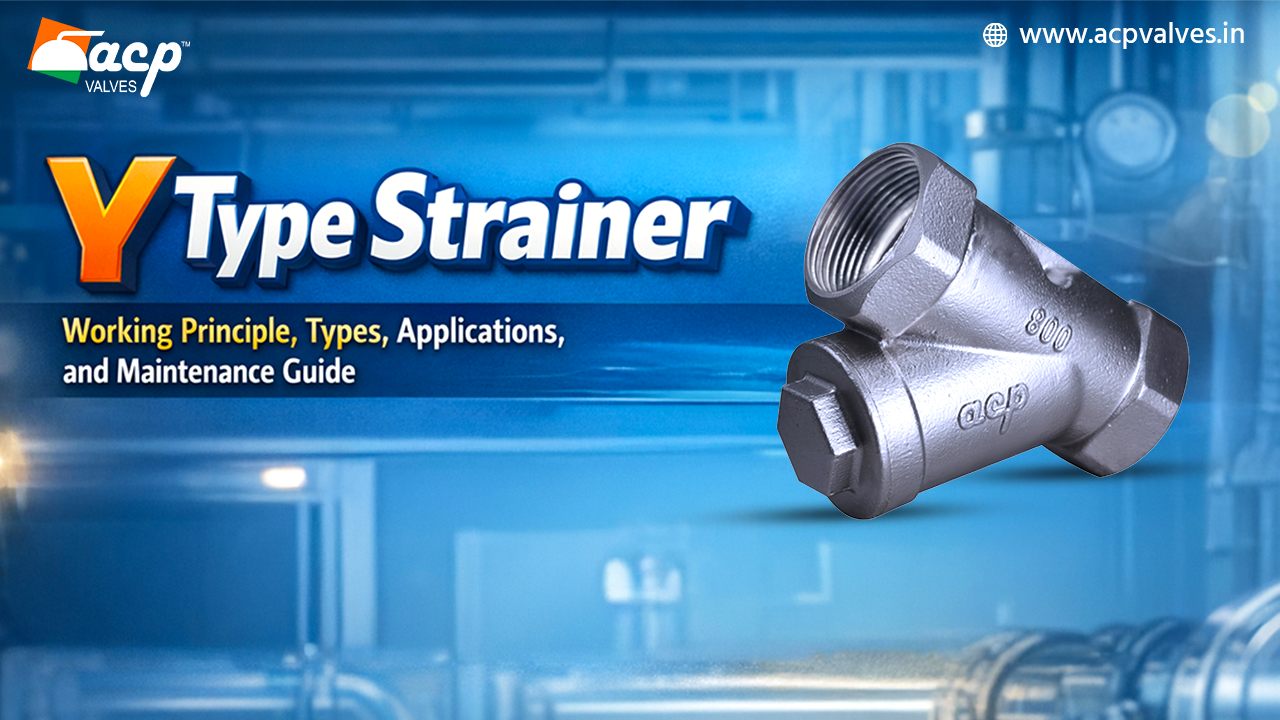
A Y Type Strainer is a pipeline filtration device used to remove dirt, rust, scale and other solid particles from flowing media. It helps protect pumps, valves, flow meters, steam traps and other industrial pipeline equipment from blockage, wear and damage.
A Y Strainer works by directing the pipeline media through an internal mesh or perforated screen. Solid contaminants are trapped inside the strainer while filtered media continues downstream.
This guide explains the Y Strainer working principle, correct flow direction, Y Strainer installation position, mesh selection, cleaning, maintenance and selection for industrial pipeline applications.
For ACP product models and connection options, view our industrial Y Type Strainer range.
What Is a Y Type Strainer?
A Y Type Strainer is a mechanical pipeline filter with a Y-shaped body containing a screen or perforated element. It is installed in piping systems to remove unwanted solid particles before they reach sensitive downstream equipment.
The terms Y Type Strainer and Y Strainer generally refer to the same filtration device. Although some users search for a “Y Strainer valve,” a strainer is primarily used for filtration and equipment protection rather than flow control.
How Does a Y Strainer Work?
The working process is simple. Pipeline media enters through the inlet and passes through the internal screen. Dirt, rust, scale and other solid particles are retained by the screen while filtered media continues through the outlet.
As debris accumulates, pressure drop across the strainer may increase. The screen should therefore be inspected and cleaned according to debris load, operating conditions and system requirements.
Y Strainer Working Principle
The Y Strainer working principle is based on mechanical filtration. Media flows through a perforated or mesh screen installed inside the Y-shaped body. Particles larger than the screen openings are retained while the cleaned media continues downstream.
- Media enters the strainer through the inlet.
- The media reaches the internal screen or mesh.
- Solid contaminants are trapped by the screen.
- Filtered media continues through the outlet.
- Collected debris is removed during cleaning or maintenance.
Typical flow path: Inlet → screen or mesh → debris retained → filtered media → outlet.
Y Strainer Flow Direction
Correct Y Strainer flow direction is essential for proper filtration. Most strainers have an arrow cast or marked on the body indicating the intended direction of flow.
The arrow should point in the same direction as the actual pipeline flow. Do not determine the flow direction only from the external shape of the body.
Always verify the manufacturer’s flow arrow, product drawing and installation instructions before commissioning the pipeline.
Y Strainer Installation Position
The correct Y Strainer installation position depends on the pipeline orientation, process media and the design of the specific strainer.
Horizontal Liquid Lines
In many horizontal liquid pipelines, the screen chamber is commonly positioned downward. This allows collected debris to remain in the chamber and supports easier maintenance.
Steam or Gas Lines
For steam or gas service, some designs may require the screen pocket to be positioned in the horizontal plane to reduce the risk of unwanted condensate collection. Follow the instructions for the specific model.
Vertical Pipelines
A Y Strainer may be installed vertically only when the product design and flow arrangement allow it. Confirm the permitted flow direction, screen orientation and cleaning access before installation.
Why Are Y Type Strainers Used in Pipelines?
Y Type Strainers are installed to reduce the amount of solid debris reaching downstream equipment. Rust, scale, welding particles and other contaminants can contribute to blockage, wear and malfunction if they are not removed.
- Protecting pumps from solid contamination
- Reducing debris reaching control valves
- Protecting steam traps
- Helping prevent blockage in meters and instruments
- Capturing rust and scale from pipelines
- Supporting reliable industrial pipeline operation
- Reducing maintenance caused by dirty media
Common Applications of Y Strainers
- Steam pipelines: Helps protect steam traps and control equipment.
- Water systems: Removes sand, rust and pipeline debris.
- Oil pipelines: Helps protect pumps, meters and other equipment.
- Gas and air lines: Filters solid contaminants where the strainer design is suitable.
- Chemical plants: Protects process equipment when materials are compatible with the media.
- HVAC systems: Helps protect pumps, coils and control components.
- Boiler systems: Removes debris before selected downstream equipment.
- Industrial process lines: Provides compact pipeline filtration.
Main Parts of a Y Type Strainer
| Part | Function |
|---|---|
| Body | Forms the main pressure-containing flow path. |
| Screen / Mesh | Retains dirt, rust, scale and solid contaminants. |
| Cover / Cap | Provides access to the screen for cleaning or replacement. |
| Gasket / Seal | Helps seal the cover joint. |
| End Connection | Connects the strainer to the pipeline. |
| Drain / Blow-off Provision | May allow draining or removal of collected debris where provided. |
Y Strainer Symbol and P&ID Representation
A Y Strainer symbol on a piping and instrumentation diagram represents a pipeline strainer used to remove solid particles from the flowing media.
The exact P&ID symbol can vary according to the drafting standard or project legend. Engineers should therefore refer to the legend used for the specific project rather than assuming one universal symbol.
Y Strainer Mesh Size and Selection
Screen or mesh selection affects filtration performance and pressure drop. A finer mesh can capture smaller particles but may clog faster, while a coarser screen can reduce pressure drop but may allow smaller contaminants to pass through.
Choose the mesh or screen opening according to:
- Particle size that must be removed
- Downstream equipment sensitivity
- Debris load
- Required flow rate
- Acceptable pressure drop
- Process media
Common Y Type Strainer Materials
Cast Iron Y Strainer
Cast iron strainers are commonly used in suitable water, HVAC and utility applications within the rated pressure and temperature limits.
Cast Steel Y Strainer
Cast steel strainers may be selected for industrial, steam, oil and process applications depending on the required material grade and pressure rating.
Stainless Steel Y Strainer
A stainless steel Y Strainer may be used where corrosion resistance or process compatibility is required. The stainless steel grade, screen and sealing materials should all be suitable for the service media.
Bronze or Brass Y Strainer
Bronze and brass strainers are used in selected water and utility applications where the material and operating rating are suitable.
How to Clean a Y Strainer
- Isolate the pipeline using the approved site procedure.
- Confirm the line is depressurised and at a safe temperature.
- Open the strainer cover according to the product instructions.
- Remove the screen carefully.
- Clean the screen using an appropriate method.
- Inspect it for corrosion, deformation or damage.
- Replace a damaged screen if necessary.
- Inspect the gasket and sealing surfaces.
- Reinstall the screen and cover correctly.
- Restart the system and check for leakage.
Y Strainer Maintenance Tips
- Monitor pressure drop across the strainer.
- Inspect the screen based on debris load.
- Clean the screen before severe blockage occurs.
- Check the cover gasket during maintenance.
- Replace damaged or corroded screens.
- Confirm that the flow arrow remains aligned with pipeline flow.
- Maintain enough clearance to remove the screen safely.
Signs That a Y Strainer Needs Cleaning
- Reduced flow rate
- Higher pressure drop
- Unstable process flow
- Unexpected downstream equipment performance
- Repeated blockage of downstream components
- Heavy debris accumulation during inspection
Y Strainer vs Basket Strainer
| Factor | Y Strainer | Basket Strainer |
|---|---|---|
| Design | Compact Y-shaped body | Larger basket chamber |
| Space Requirement | Generally more compact | Usually requires more space |
| Dirt-Holding Capacity | Generally lower | Generally higher |
| Typical Applications | Steam, water, gas and utility systems | Liquid systems with higher debris loads |
| Maintenance | Screen removed through cover | Basket removed from chamber |
How to Choose the Right Y Type Strainer
Pipe size alone is not enough to select a strainer. The product should be matched to actual operating conditions.
- Service media: Water, steam, oil, gas, air or process fluid
- Working pressure: Normal and maximum operating pressure
- Temperature: Normal and peak process temperature
- Body material: Select according to corrosion and media compatibility
- Screen opening: Match filtration requirements
- Flow conditions: Consider flow rate and pressure drop
- End connection: Screwed, flanged or other specified connection
- Installation orientation: Confirm manufacturer instructions
- Maintenance clearance: Allow space for screen removal
- Documentation: Confirm inspection and testing requirements
ACP Y Type Strainer Options
ACP Valves publishes screwed-end and flanged-end Y Strainer options for industrial pipeline applications. Selection should be based on service media, size, pressure, temperature, connection and screen requirements.
| ACP Series | Type | Published Size Range | Published Working Pressure |
|---|---|---|---|
| ACP 3060 | Y-Strainer Screwed End | ½” to 2” (DN15 to DN50) | 800 WOG |
| ACP 4160 | Y-Strainer Flanged End | 1” to 4” (DN25 to DN100) | 800 WOG |
For current specifications and available models, view the ACP Y Type Strainer range.
FAQs About Y Type Strainers
What is a Y Type Strainer?
A Y Type Strainer is a pipeline filtration device that removes solid particles such as dirt, rust and scale from flowing media before they reach downstream equipment.
Is a Y Type Strainer the same as a Y Strainer?
Yes. Y Type Strainer and Y Strainer generally refer to the same Y-shaped pipeline filtration device.
How does a Y Strainer work?
A Y Strainer directs media through an internal screen. Solid particles are trapped while filtered media continues through the pipeline.
What is the correct Y Strainer flow direction?
The arrow marked on the strainer body should point in the actual direction of pipeline flow.
What is the correct Y Strainer installation position?
The correct installation position depends on the media, pipeline orientation and specific strainer design. Manufacturer instructions should always take priority.
Can a Y Strainer be installed vertically?
Vertical installation is possible only where the specific model and flow arrangement permit it. Check the manufacturer’s installation instructions before installation.
Where should a Y Strainer be installed?
A Y Strainer is commonly installed upstream of equipment that needs protection from debris, including pumps, control valves, meters and steam traps.
How do you clean a Y Strainer?
Isolate and depressurise the pipeline, remove the strainer cover and screen, clean and inspect the screen, reinstall the components and check for leakage during restart.
How do I choose Y Strainer mesh size?
Select mesh size according to the particle size to be removed, downstream equipment requirements, debris load and acceptable pressure drop.
What is the difference between a Y Strainer and a basket strainer?
A Y Strainer has a compact Y-shaped design, while a basket strainer usually has a larger debris-holding chamber and may be preferred for applications with higher contaminant loads.
Conclusion
A Y Type Strainer helps protect industrial pipeline equipment by removing unwanted solid contaminants before they reach downstream components. Correct screen selection, flow direction, installation position and regular maintenance are essential for reliable filtration.
Understanding the Y Strainer working principle and installation requirements can help reduce equipment damage, pressure-drop problems and unnecessary maintenance.
For current ACP screwed-end and flanged-end options, review the ACP Y Type Strainer range or contact ACP Valves with your media, size, pressure, temperature, connection and screen requirements.