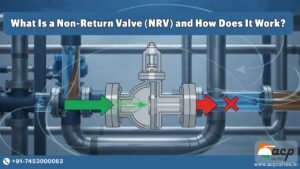
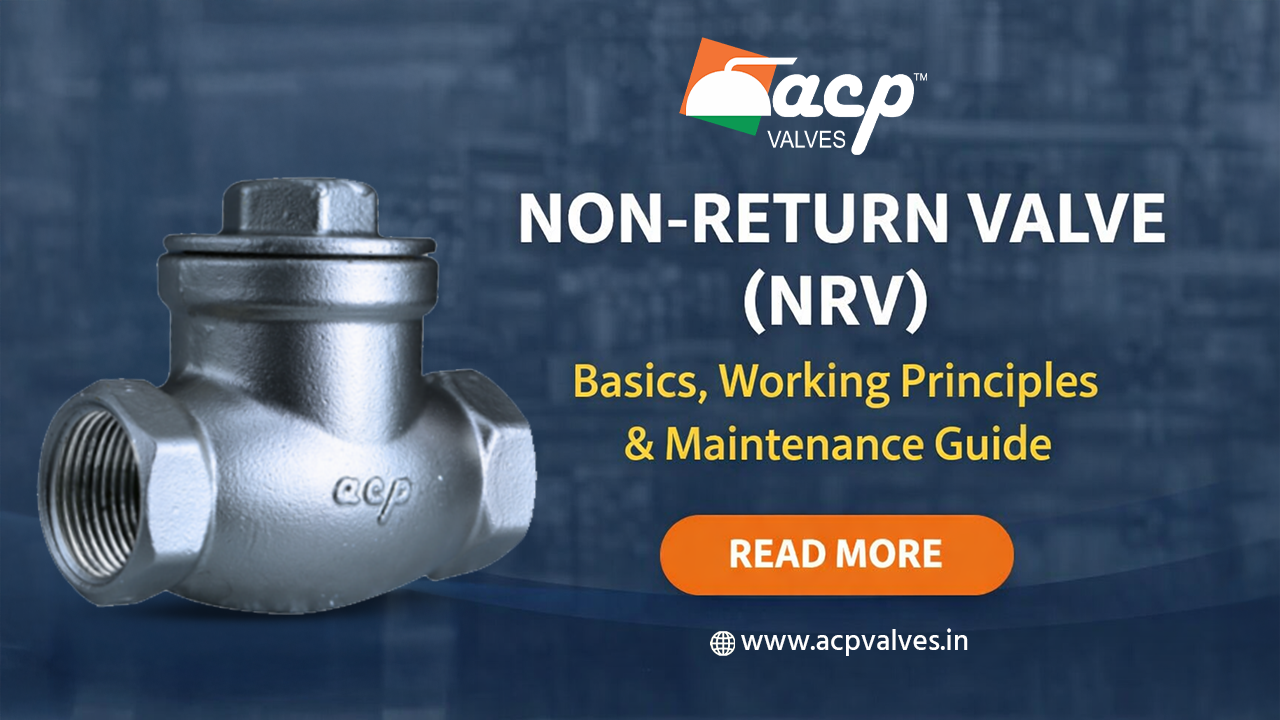
A non return valve, abbreviated as NRV and also called a check valve, is an automatic one-way valve. It permits liquid or gas to move in the required direction and closes when flow stops or reverses, helping protect pumps, compressors, boilers and pipelines from backflow.
A non return valve is used wherever reverse flow could damage equipment, contaminate media or disturb a process. The valve operates automatically; it does not normally need a handwheel, actuator or operator to open and close during service.
This guide explains the NRV full form, common non return valve types, applications, selection factors, installation checks, faults and maintenance. For a deeper explanation of pressure differential, cracking pressure and closing action, read how a non return valve works.
What Is a Non Return Valve?
A non return valve is a mechanical valve designed to maintain one-way flow. Forward pressure moves the closing element away from the seat. When the pressure difference becomes insufficient—or outlet pressure becomes higher—the disc, plate, piston or ball returns to the seat and blocks reverse flow.
What is the full form of NRV?
NRV stands for Non Return Valve. In industrial specifications, catalogues and conversations, the terms NRV, NRV valve and check valve are generally used for the same valve function: allowing forward flow and preventing backflow.
Main functions of an NRV
- Prevents liquid or gas from flowing backward.
- Protects pumps and compressors after shutdown.
- Reduces the risk of process contamination or media mixing.
- Helps maintain pressure and prime in selected pumping systems.
- Protects downstream and upstream equipment from reverse-flow damage.
- Supports safer operation in water, steam, oil, gas, chemical and air lines.
Why Non Return Valves Are Important
Backflow is not merely an efficiency problem. It can rotate a pump backward, damage seals, empty a discharge line, contaminate clean media, create pressure shocks or send process fluid into equipment that is not designed to receive it.
For example, an NRV installed after a pump closes when the pump stops, limiting reverse movement from the discharge line. In a boiler feed line, it helps stop high-pressure water from returning toward the feed pump. In chemical dosing systems, it can prevent process fluid from entering the dosing line.
Important: An NRV is a backflow-prevention device, not a substitute for a dedicated isolation valve or safety valve. Maintenance personnel should still isolate and depressurise the line according to the plant procedure.
Common Types of Non Return Valves
The best NRV type depends on the media, velocity, pressure, temperature, orientation, available space and acceptable pressure drop. The following designs are commonly used in industrial and utility systems.
1. Swing Check Valve
A swing check valve uses a hinged disc. Forward flow swings the disc away from the seat; reverse flow pushes it closed. It is widely used for water and general liquid service where relatively low pressure loss is required.
2. Lift Check Valve
A lift check valve uses a guided disc or piston that rises from the seat during forward flow. It is commonly considered for clean media, steam and higher-pressure services, subject to the manufacturer’s installation instructions.
3. Dual Plate or Wafer Check Valve
A dual plate check valve has two spring-assisted plates in a compact wafer body. Its short face-to-face dimension and faster closing response make it useful where installation space is limited or reverse-flow control must be quicker.
4. Ball Check Valve
A ball check valve uses a free-moving or guided ball as the closure. It is used in selected water, wastewater, slurry, pump and process applications where the ball-and-seat design suits the media.
5. Spring-Loaded Disc Check Valve
A spring-loaded disc check valve uses spring force to assist closing. It may be installed in more orientations than some gravity-dependent designs, but actual orientation and cracking pressure must be confirmed from the product datasheet.
6. Piston, Tilting-Disc and Non-Slam Check Valves
Engineered systems may use piston, tilting-disc, axial-flow or non-slam check valves to achieve controlled closing, high-pressure service or reduced slam. These designs require careful sizing against dynamic flow conditions.
| NRV type | Typical use | Main advantage | Key selection concern |
|---|---|---|---|
| Swing check | Water and general liquid lines | Relatively low pressure drop | Closing response and orientation |
| Lift check | Clean media, steam, pressure service | Guided closure and sealing | Pressure loss and installation position |
| Dual plate / wafer | Compact industrial pipelines | Short face-to-face and fast closing | Spring and seat compatibility |
| Ball check | Water, wastewater and selected slurry lines | Simple closure design | Ball material and solids content |
| Spring-loaded disc | Utility and process systems | Quick response and orientation flexibility | Cracking pressure and pressure drop |
| Non-slam / axial | Critical pump and high-velocity systems | Controlled closure | Dynamic sizing and project specification |
Where Are Non Return Valves Used?
NRVs are found in small plumbing systems as well as large industrial plants. The application determines the required design, material, pressure class and testing standard.
- Water pumps: Installed on pump discharge lines to limit reverse flow after shutdown.
- Water supply and plumbing: Used to maintain one-way movement and protect connected systems.
- Boiler feed systems: Helps prevent reverse flow from higher-pressure boiler circuits.
- Steam lines: Used where condensate or steam reversal could affect equipment.
- Compressed-air systems: Protects compressors, receivers and branch lines.
- Chemical dosing: Reduces the risk of process media entering a dosing line.
- Oil and gas: Supports directional flow in hydrocarbon and process systems.
- Fire-fighting systems: Used in pump and water-control arrangements subject to applicable approvals.
- HVAC systems: Maintains intended direction in circulation and utility lines.
- Wastewater and slurry: Selected ball or specialised check-valve designs may handle solids better than conventional designs.
Where rust, scale or particles can reach the valve, an upstream Y type strainer may help protect the seat and moving parts, provided the strainer is suitable for the media and flow conditions.
What Is the NRV Symbol in a P&ID?
In a piping and instrumentation diagram, the NRV or check-valve symbol indicates a one-way valve and usually shows the permitted flow direction. The exact graphic can vary between ISO, ISA, project and company drafting standards. Always check the drawing legend rather than relying on a symbol copied from another project.
For technical drawings and quotations, specify the valve type as well as the tag—for example, swing check valve, dual plate check valve or spring-loaded NRV.
How to Select the Right Non Return Valve
Selecting only by nominal pipe size can lead to chatter, excessive pressure loss, slam or leakage. Provide the manufacturer with complete operating data so the valve can be matched to the actual service.
Important selection factors
- Media: Water, steam, air, oil, gas, chemical, wastewater or slurry.
- Normal and maximum pressure: Include operating, design and test conditions.
- Operating temperature: Body, trim, seat and spring materials must remain suitable.
- Flow rate and velocity: Needed to check valve opening, stability and pressure drop.
- Pipe size and schedule: Confirm bore and end dimensions.
- Installation orientation: Horizontal, vertical-up or another approved position.
- End connection: Flanged, wafer, screwed, socket weld or butt weld.
- Body and trim material: Cast iron, ductile iron, carbon steel, stainless steel, bronze or special alloy.
- Seat type: Metal seat or resilient seat based on leakage, media and temperature.
- Closing behaviour: Consider slam risk, pulsating flow and pump characteristics.
- Standards and documentation: Specify design, testing, material certificates and approvals.
For available industrial constructions, view ACP Valves’ non return valve and check valve range.
Non Return Valve Installation and Flow Direction
The arrow marked on the valve body must point in the intended process-flow direction. A reversed valve may remain closed during normal operation or fail to prevent backflow.
- Confirm the valve’s approved orientation before installation.
- Support the pipeline so the valve does not carry excessive pipe load.
- Remove welding debris, scale and foreign material before commissioning.
- Provide straight-run distance where required by the valve or pump manufacturer.
- Avoid installing a gravity-dependent swing or lift design in an unapproved orientation.
- Check that gaskets and flange bolts do not obstruct the bore or distort the body.
- Commission gradually and watch for noise, chatter, leakage or pressure shock.
Detailed opening, closing and flow-direction behaviour is covered in the separate NRV working principle guide.
Common NRV Materials
| Material | Typical application | Buyer check |
|---|---|---|
| Cast iron / ductile iron | Water, utility and HVAC services | Pressure rating, lining and corrosion conditions |
| Carbon steel | Steam, oil, gas and industrial process lines | Temperature, corrosion allowance and trim |
| Stainless steel | Corrosive, hygienic and chemical applications | Grade such as CF8/304 or CF8M/316 and media compatibility |
| Bronze / brass | Plumbing, water and selected steam services | Pressure-temperature rating and dezincification risk |
| Special alloys / lined valves | Aggressive or high-purity media | Project-specific corrosion and permeation data |
For corrosion-resistant applications, also review ACP Valves’ guide to stainless steel valves.
Common NRV Problems and Troubleshooting
| Symptom | Possible cause | Recommended check |
|---|---|---|
| Reverse leakage | Debris, worn seat, damaged disc or insufficient closing force | Isolate, inspect seat and closure, clean or replace parts |
| Chattering | Oversized valve, low or unstable flow, pulsation | Review actual flow rate and valve sizing |
| Valve slam / water hammer | Delayed closure, high reverse velocity or unsuitable valve type | Review pump trip behaviour and closing characteristics |
| High pressure drop | Undersized valve, blocked passage or high cracking pressure | Check bore, deposits, flow rate and spring specification |
| No forward flow | Reversed installation, jammed closure or inadequate differential pressure | Check body arrow, free movement and operating pressure |
| Noise and vibration | Turbulence, unstable disc position or poor support | Inspect installation, straight run, supports and sizing |
Do not dismantle a pressurised valve. Follow the plant’s isolation, lockout and depressurisation procedure before inspection.
Non Return Valve Maintenance Checklist
Maintenance frequency should be based on service severity, cycle frequency, media cleanliness, plant criticality and the manufacturer’s instructions. A clean-water utility valve may not need the same inspection interval as an NRV handling steam, slurry or corrosive chemicals.
- Review operating records for pressure fluctuations, noise or repeated pump trips.
- Inspect the body, bonnet, cover and joints for external leakage or corrosion.
- Confirm the valve remains installed in the correct flow direction.
- Check the disc, plates, piston or ball for free movement.
- Remove debris and deposits from the flow path and seat area.
- Inspect the seat, hinge, shaft, spring and guides for wear or damage.
- Replace seals, springs and internal parts with compatible components.
- Perform pressure or seat-leak testing when required by the maintenance plan.
- Record the inspection date, findings, replaced parts and next due date.
Is a Non Return Valve the Same as a Check Valve?
Yes. In most industrial and plumbing contexts, non return valve and check valve describe the same one-way function. The preferred term varies by region, industry and product catalogue. The design name—such as swing, lift, dual plate or ball check—is more useful when specifying a product.
An NRV is different from an isolation valve because it closes automatically according to flow conditions. It is also different from a safety valve, which opens to relieve excessive pressure.
Need Help Selecting an Industrial NRV?
Send ACP Valves the media, size, pressure, temperature, end connection, material, quantity and installation orientation. The team can help identify a suitable check-valve construction for your application.
View non return valves | Send your requirement | Compare NRV manufacturers
Frequently Asked Questions
1. What is a non return valve?
A non return valve is an automatic one-way valve that permits forward flow and closes when flow stops or reverses, helping prevent backflow.
2. What is the full form of NRV?
NRV stands for Non Return Valve. It is also commonly called a check valve.
3. What are the main types of NRV?
Common types include swing, lift, dual plate or wafer, ball, spring-loaded disc, piston, tilting-disc and non-slam check valves.
4. Where should an NRV be installed on a pump?
An NRV is commonly installed on the pump discharge line. The exact location, straight-run requirement and orientation should follow the pump, valve and project specifications.
5. Can an NRV be installed vertically?
Some NRV designs support vertical upward flow, while others require horizontal installation. Confirm the approved orientation in the manufacturer’s datasheet.
6. Which NRV is best for water?
Swing, dual plate, ball and spring-loaded check valves are all used in water systems. The correct choice depends on size, velocity, pump behaviour, solids, pressure drop and slam risk.
7. Why does a non return valve leak?
Common causes include dirt on the seat, worn seals, corrosion, damaged closure components, incorrect sizing, low differential pressure or installation in the wrong orientation.
8. How often should an NRV be maintained?
There is no single interval for every application. Inspection frequency should reflect media cleanliness, pressure, temperature, cycle frequency, criticality and the manufacturer’s recommendations.
9. Does an NRV stop water hammer?
An appropriate fast-closing or non-slam design can reduce reverse velocity and valve slam, but complete water-hammer control may require system-level analysis and additional measures.
Conclusion
A non return valve is a simple but critical pipeline component. Reliable performance depends on selecting the correct type, material, size, orientation and closing behaviour—not merely matching the pipe diameter. Proper installation and planned maintenance help the valve prevent backflow without creating excessive pressure loss, noise or slam.