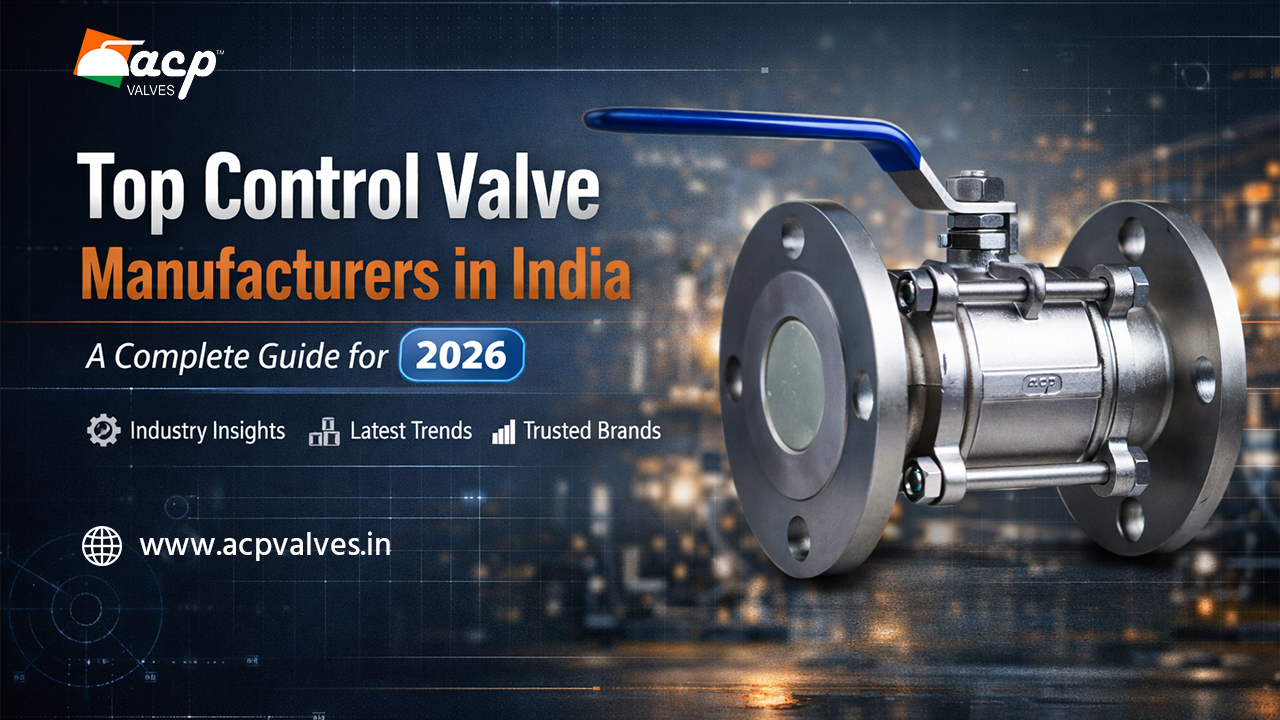
Choosing the right control valve manufacturer in India is important for industrial systems that need stable flow, pressure, temperature or process regulation. Control valves are used across steam systems, water treatment plants, chemical processing, power generation, oil and gas applications, HVAC systems and industrial process pipelines.
For project engineers, plant teams and industrial buyers, manufacturer selection should not be based only on valve price. Valve type, body material, trim design, actuator compatibility, pressure rating, temperature suitability, flow requirement, testing support and technical guidance can all affect long-term control performance.
ACP Valves supports industrial buyers with valves, boiler mounting products, pipe fittings and related industrial valve products for steam, water, oil, gas and process pipeline applications.
Quick Answer
A reliable control valve manufacturer in India should help buyers evaluate valves according to media, flow rate, inlet pressure, outlet pressure, temperature, pressure drop, valve type and actuator requirement. Buyers should compare technical capability, material options, testing support, documentation and application knowledge before selecting a supplier.
Top 10 Control Valve Manufacturers in India
The following control valve manufacturers and industrial flow-control brands are commonly evaluated for different process applications. Product range, manufacturing capability, application focus and local support can vary, so buyers should verify technical specifications and project suitability before final selection.
Note: This list is provided as an industrial buyer comparison guide. It is not an independent certification-based ranking of manufacturers.
1. ACP Valves
ACP Valves supports industrial valve and pipeline product requirements for steam, water, oil, gas and general process applications. Its wider industrial product focus includes valves, fittings and boiler mounting products.
For industrial buyers comparing control valve manufacturers in India, ACP Valves can be considered where application details, valve requirements and related pipeline product sourcing need to be evaluated together.
Best suited for: Industrial valve sourcing, process pipeline requirements and buyers evaluating multiple valve and flow-control categories.
2. Forbes Marshall / ARCA
Forbes Marshall has a dedicated control and industrial valve portfolio. Its control-valve offering includes ARCA-related solutions and valve designs for industrial process and steam applications.
The product range includes control-valve solutions such as three-way designs with pneumatic or electric actuator options for suitable applications.
Best suited for: Steam systems, industrial process control and engineered control applications.
3. KSB MIL Controls
KSB MIL Controls focuses on control-valve technology for industrial process applications. Its product range includes general-service control valves, severe-service control valves, special control valves, rotary valves and actuators.
Industrial buyers may evaluate KSB MIL for applications requiring engineered control-valve selection and process-specific solutions.
Best suited for: General service, severe service and engineered process control applications.
4. Dembla Valves
Dembla Valves manufactures control valves and manual industrial valves. Its product portfolio includes globe control valves and other industrial valve designs for different flow-control applications.
Its range can be evaluated for buyers requiring globe-style control valves, rotary valve designs and selected process valve requirements.
Best suited for: Globe control valves, industrial process systems and selected severe-service requirements.
5. Instrumentation Limited
Instrumentation Limited is listed by India’s Ministry of Heavy Industries as a provider of control valves and related industrial products for process industries.
Its documented activities include designing, engineering, machining, assembly, testing, calibration, inspection, supply and servicing of control valves and related products.
Best suited for: Process industries, engineered valve requirements and applications requiring technical testing and inspection support.
6. Aira Euro Automation
Aira Euro Automation provides pneumatic control valves for industrial process applications. Its control-valve portfolio focuses on pneumatically operated designs used for flow regulation and industrial automation requirements.
Buyers may evaluate Aira where pneumatic actuation and process automation are major parts of the valve requirement.
Best suited for: Pneumatic control valves, process automation and actuated industrial valve applications.
7. Emerson Fisher
Emerson’s Fisher portfolio includes control valves, actuators, regulators and valve instrumentation for process-control applications.
Fisher control valves are used to regulate process media such as gas, steam, water and chemical compounds according to the operating and control requirements of the system.
Best suited for: Process automation, engineered control systems and demanding industrial control applications.
8. Flowserve Valtek
Flowserve’s Valtek portfolio includes control-valve systems combining valves, actuators and positioners. Valtek control-valve products are used in petrochemical, oil and gas, water and general industrial applications.
The range includes linear globe and angle control-valve designs for liquid and gaseous services.
Best suited for: Oil and gas, petrochemical and engineered process-control applications.
9. Valmet / Neles
Valmet’s Neles flow-control portfolio includes industrial control valves for process applications. The broader control-valve range includes different valve technologies for regulating industrial process flow.
Neles control-valve solutions are considered in industries where process stability, flow regulation and application-specific valve selection are important.
Best suited for: Refining, petrochemical and demanding industrial process-control applications.
10. Spirax Sarco India
Spirax Sarco India provides control-valve solutions with a strong focus on steam systems. Its control portfolio includes valve solutions used for steam pressure and temperature regulation.
The range includes different control-valve and actuator options for suitable steam and industrial control applications.
Best suited for: Steam systems, pressure control and temperature regulation applications.
Comparison of Control Valve Manufacturers in India
| Manufacturer | Best Suited For | Buyer Check Point |
|---|---|---|
| ACP Valves | Industrial valve and pipeline sourcing | Application and project requirement |
| Forbes Marshall / ARCA | Steam and process control | Control requirement and actuator selection |
| KSB MIL Controls | Engineered and severe-service applications | Process data and operating conditions |
| Dembla Valves | Globe and industrial control valves | Trim, materials and pressure conditions |
| Instrumentation Limited | Engineered process applications | Project specification and inspection |
| Aira Euro Automation | Pneumatic control valves | Actuator and automation requirement |
| Emerson Fisher | Process automation | Sizing and control requirements |
| Flowserve Valtek | High-specification process systems | Service and operating conditions |
| Valmet / Neles | Refining and process industries | Media and control performance |
| Spirax Sarco India | Steam and temperature control | Steam pressure and temperature |
What Is a Control Valve?
A control valve is an industrial valve used to regulate a process variable such as flow, pressure, temperature or liquid level. The valve changes its opening according to process requirements and can work with an actuator, positioner and industrial control system.
Unlike a standard isolation valve that normally works in a fully open or fully closed position, a control valve may continuously adjust its position to maintain the required process condition.
For a deeper technical explanation of valve working, components, sizing and selection, read the control valve types and working guide.
Why Control Valve Manufacturer Selection Matters
A control valve directly affects process stability. Incorrect valve selection can cause unstable flow, excessive pressure drop, noise, vibration, leakage, poor response and higher maintenance requirements.
A suitable manufacturer or supplier should understand the operating data instead of recommending a valve only according to pipeline size.
Important Process Details Include
- Process media
- Minimum, normal and maximum flow rate
- Inlet pressure
- Outlet pressure
- Operating temperature
- Pressure drop across the valve
- Pipeline size
- Body and trim material requirement
- Actuator requirement
- Fail-open or fail-closed requirement
- Testing and documentation requirements
Common Types of Industrial Control Valves
Control valve manufacturers may support different designs according to process conditions, control accuracy and installation requirements.
1. Globe Control Valve
A globe control valve uses linear movement to position a plug or disc relative to the valve seat. Globe-style control valves are widely considered where accurate throttling and controlled flow adjustment are important.
Buyers evaluating globe-style industrial valve designs can also review the guide to globe valve manufacturers in India.
2. Ball Control Valve
A ball control valve uses rotary movement to change the flow opening. Special ball and trim designs may be used for selected control applications where flow capacity and rotary operation are important.
3. Butterfly Control Valve
A butterfly control valve uses a rotating disc inside the valve body. It can be suitable for larger pipeline sizes and applications where compact design and lower valve weight are important.
4. Diaphragm Control Valve
A diaphragm control valve uses a flexible diaphragm in its valve design. Depending on material and process conditions, these valves may be considered for selected chemical, water and process applications.
5. Three-Way Control Valve
A three-way control valve is used for mixing or diverting flow. These valves are used in process circulation, heating, cooling and selected temperature-control applications.
Control Valve Types Comparison
| Control Valve Type | Movement | Common Application |
|---|---|---|
| Globe Control Valve | Linear | Accurate throttling and process control |
| Ball Control Valve | Rotary | Selected higher-flow applications |
| Butterfly Control Valve | Rotary | Larger pipelines and compact systems |
| Diaphragm Control Valve | Linear | Selected chemical and process systems |
| Three-Way Control Valve | Linear or rotary | Mixing and diverting service |
How to Compare Control Valve Manufacturers in India
When comparing control valve manufacturers in India, buyers should check technical capability and application support rather than depending only on a product catalogue.
1. Application Knowledge
The supplier should understand the process media, pressure, temperature, flow conditions and control requirement before recommending a valve.
2. Valve Type Options
Check whether the supplier can support suitable globe, ball, butterfly, diaphragm or other control valve designs required for the project.
3. Material Selection
Body and trim materials should be selected according to media compatibility, corrosion conditions, pressure and temperature.
4. Flow and Pressure Data
A manufacturer should consider the actual process flow and differential pressure conditions. Selecting a control valve only according to line size can result in poor control performance.
5. Actuator Compatibility
The actuator should provide sufficient force or torque for actual operating conditions. Pneumatic, electric or other suitable actuation systems may be considered according to automation requirements.
6. Testing Support
Buyers should confirm required hydro testing, leakage testing, functional inspection and other project-specific testing before ordering.
7. Documentation
Depending on project requirements, buyers may need material documents, testing records, dimensional details or inspection support.
8. Technical Support
A suitable supplier should help clarify valve type, material, actuator and application suitability before final selection.
Control Valve Manufacturer Selection Checklist
| Selection Point | What Buyers Should Check |
|---|---|
| Application | Steam, water, oil, gas or process service |
| Valve Design | Suitable control valve type |
| Flow Data | Minimum, normal and maximum flow |
| Pressure | Inlet, outlet and differential pressure |
| Temperature | Normal and maximum operating temperature |
| Materials | Body, trim, seat and sealing suitability |
| Actuator | Operating method and required force or torque |
| Testing | Required inspection and test support |
| Documentation | Project and material documentation requirements |
| Technical Support | Application and selection guidance |
Industries That Use Control Valves
Industrial control valves are used in systems where process conditions must be regulated accurately or automatically.
- Oil and gas systems
- Chemical and petrochemical plants
- Power generation
- Steam and boiler systems
- Water treatment plants
- Process manufacturing
- Pharmaceutical plants
- Food and beverage processing
- HVAC systems
- Industrial utility networks
Control Valves for Steam and Boiler Applications
Steam and boiler applications require careful consideration of pressure, temperature, pressure drop, valve body material, trim and actuator requirements.
The valve should be selected according to actual operating data. High temperature, high differential pressure or unstable process conditions may require additional technical review before valve selection.
Control Valves for Water Treatment Systems
Water treatment plants use control valves to regulate flow and process conditions in pumping, treatment and distribution systems.
Valve body material, seat and trim selection should match water quality, pressure and process requirements. Actuated control valves may also be integrated with plant automation systems where automatic regulation is required.
Control Valves for Chemical and Process Plants
Chemical and process applications require careful media compatibility checks. Body material, internal trim, seals and packing should be selected according to the actual process fluid, concentration, pressure and temperature.
Buyers should provide complete process information before ordering valves for corrosive or demanding media.
Common Buying Mistakes
- Selecting a control valve only by pipeline size.
- Not providing minimum and maximum flow data.
- Ignoring inlet and outlet pressure.
- Using unsuitable body or trim material.
- Selecting an actuator without checking required force or torque.
- Ignoring the required fail position.
- Buying only according to the lowest quoted price.
- Not confirming testing and documentation requirements.
- Using manufacturer claims without verifying project suitability.
Questions to Ask a Control Valve Supplier
Before placing an order, buyers can ask the supplier:
- Which control valve type is suitable for the application?
- What process data is required for valve selection?
- Which body and trim materials are recommended?
- What pressure and temperature conditions can the valve support?
- Which actuator type is suitable?
- What fail position is recommended?
- What testing can be provided?
- Which documents are available?
- What maintenance access is required?
- What project details should be shared before quotation?
Why ACP Valves?
ACP Valves supports industrial buyers with valves, boiler mounting products, pipe fittings and flow-control products for industrial pipeline applications.
For industrial valve requirements, buyers should share process media, minimum and maximum flow, inlet pressure, outlet pressure, temperature, valve size, material requirement, actuator requirement and application details.
Industrial buyers comparing a wider product range can also review this guide to valve manufacturers in India.
Send your requirement: Contact ACP Valves
FAQs About Control Valve Manufacturers in India
How do I choose a control valve manufacturer in India?
Compare manufacturers based on application knowledge, valve type options, material suitability, actuator support, testing, documentation and technical guidance.
What information is required before buying a control valve?
Share media, minimum and maximum flow rate, inlet pressure, outlet pressure, temperature, line size, material requirement, actuator requirement and fail position.
What types of control valves are used in industrial applications?
Common designs include globe control valves, ball control valves, butterfly control valves, diaphragm control valves and three-way control valves.
Why is control valve sizing important?
Incorrect sizing can cause unstable process control, excessive pressure drop, noise and poor valve response. Control valve selection should consider actual process flow and pressure conditions.
Are control valves used in steam systems?
Yes. Control valves are used in steam and boiler systems to regulate suitable process conditions. Valve material, pressure, temperature, trim and actuator requirements should be checked before selection.
Can control valves be automated?
Yes. Depending on the application, control valves can work with pneumatic, electric or other suitable actuators and process-control systems.
What should I check before comparing control valve suppliers in India?
Check technical support, product suitability, materials, actuator options, testing, documentation and the supplier’s ability to understand the actual process requirement.
Conclusion
Selecting the right control valve manufacturer in India requires more than comparing catalogue specifications or prices. Buyers should evaluate application knowledge, valve design, materials, actuator compatibility, process data, testing and technical support.
The manufacturers in this guide serve different industrial requirements and application areas. Buyers should compare the actual valve specification, process conditions, testing requirements and technical support before making a final supplier decision.
Before requesting a quotation, prepare complete flow, pressure, temperature, media and automation details so the valve requirement can be evaluated properly.