
Urgent Call?
+91-7453000063
Email Us
sales@acpvalves.in
+91-7453000063
sales@acpvalves.in
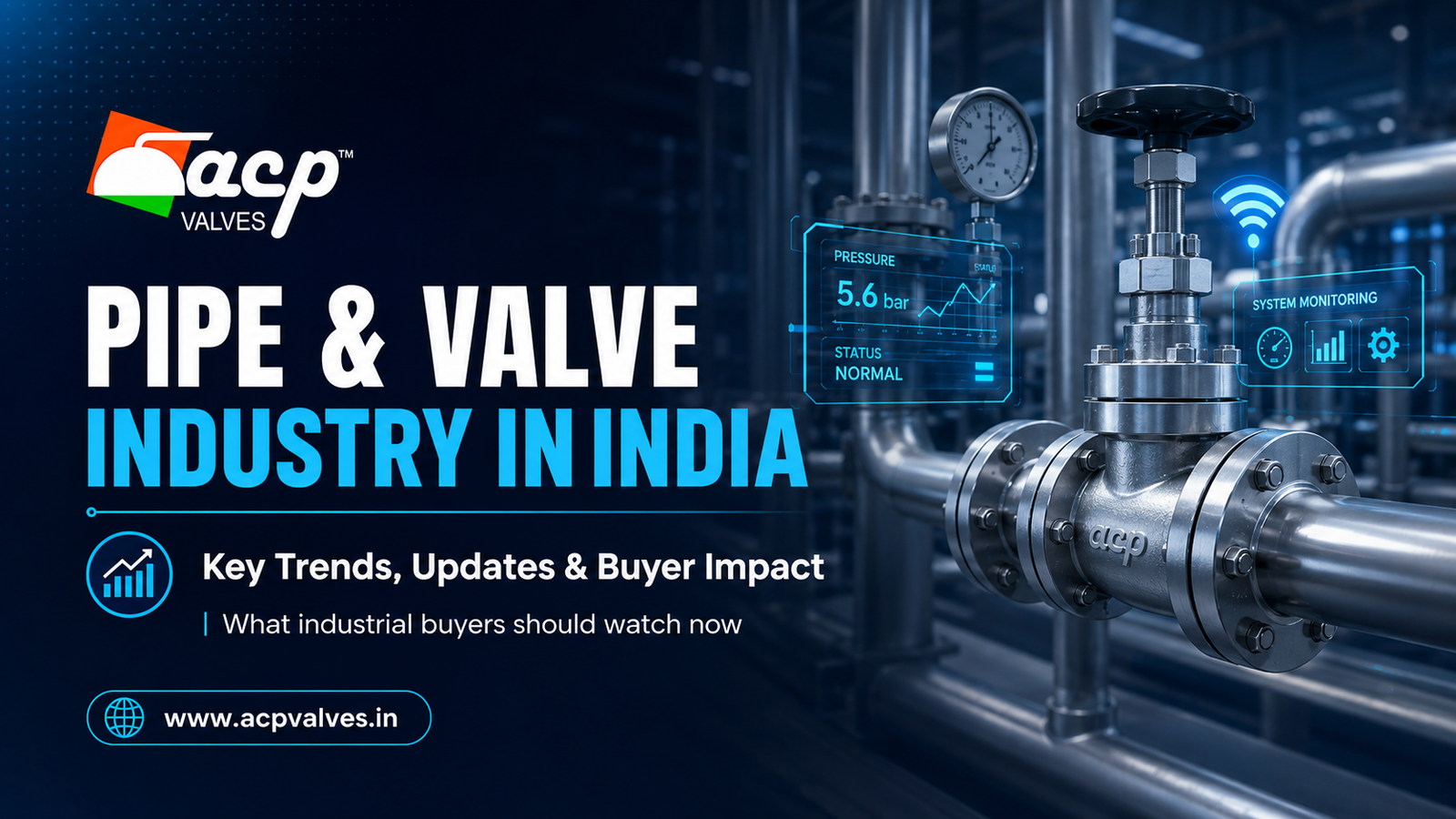
India’s industrial valve sector is moving through a period of steady expansion as investment continues across water infrastructure, oil and gas, chemicals, power, manufacturing and process industries. At the same time, industrial buyers are paying closer attention to materials, testing, documentation, automation compatibility and long-term valve performance.
The industrial valves market in India in 2026 is therefore being shaped by more than project volume alone. Changes in infrastructure investment, industrial automation, material requirements and procurement practices are also influencing how valves are selected, manufactured and used.
2026 market snapshot: Published market estimates differ because research firms use different product scopes and methodologies. However, major industry studies point in the same overall direction: continued growth supported by infrastructure development, industrial expansion, water and wastewater projects, oil and gas activity and increasing adoption of automation.
| Indicator | 2026 Outlook |
|---|---|
| Overall direction | Continued industrial market growth |
| Major demand sectors | Oil & gas, water & wastewater, chemicals, power, utilities and process industries |
| Important valve categories | Ball, butterfly, globe, check/non return, gate, safety and control valves |
| Material trend | Greater attention to stainless steel and corrosion-resistant materials |
| Technology trend | Increasing use of actuated, monitored and automation-ready valve systems |
| Procurement trend | Greater focus on testing, traceability, documentation and lifecycle performance |
There is no single universally accepted figure for the size of the India valves market. Market research companies may include different valve categories, end-use industries and related products when calculating market size.
For that reason, published estimates should be understood according to the scope and methodology of each report rather than treated as directly interchangeable figures.
| Published Source | 2026 Estimate | Forecast |
|---|---|---|
| Mordor Intelligence | Approximately USD 1.67 billion | Approximately USD 2.34 billion by 2031, with a reported CAGR of 6.96% |
| IMARC Group | Approximately USD 3.8 billion | Approximately USD 6.3 billion by 2034, with a reported CAGR of 6.64% |
Although the estimates differ, both indicate a growing market. For industrial buyers and manufacturers, the more useful takeaway is that demand for flow-control equipment is expected to continue expanding as Indian infrastructure and process industries develop.
The growth of the industrial valve industry in India is connected to several major end-use sectors. Each application has different requirements for pressure, temperature, process media, materials, valve function and operating method.
Water distribution systems, treatment plants, sewage networks, pumping stations and wastewater-reuse projects require valves throughout their pipeline networks for isolation, backflow prevention, equipment protection and flow management.
Public water programmes and urban infrastructure projects continue to support investment in water supply, treatment, distribution and wastewater systems across India.
Butterfly valves are often considered for larger pipeline sizes because of their compact construction, while non return valves play an important role around pumps and transfer systems where reverse flow needs to be prevented.
Oil and gas continues to be an important end-use sector for industrial valves. Refineries, terminals, process plants, transmission pipelines and city-gas networks require valves for isolation, pressure management, flow control and safety duties.
Valve specifications in these applications depend heavily on operating pressure, process media, shut-off requirements, body and trim materials, end connections and applicable project standards.
Quarter-turn valves such as ball valves are widely used where fast isolation and reliable shut-off are required.
Chemical, pharmaceutical and other process industries require careful valve selection because process-fluid compatibility can vary significantly between applications.
Material selection is especially important. Stainless steel and other corrosion-resistant materials may be considered where the process media, environment or cleanliness requirements justify their use.
However, the correct material should always be selected according to actual media composition, concentration, operating pressure, temperature and project requirements.
Power plants, boiler systems and industrial utility networks use different valve types for steam isolation, condensate systems, pressure protection, flow management and equipment protection.
Applications involving elevated pressure or temperature require particular attention to pressure class, material compatibility, valve design, seat arrangement, testing and documentation.
As industrial plants become more automated, valves increasingly need to work as part of wider plant-control systems rather than only as manually operated mechanical components.
Pneumatic and electric actuators, position feedback, limit switches, solenoid valves and positioners can allow valves to be remotely operated or integrated into plant automation systems.
This is increasing demand for valve configurations that consider both mechanical performance and automation requirements.
The Indian industrial valve market includes several valve designs because different pipeline functions require different operating characteristics.
| Valve Type | Primary Function | Common Applications |
|---|---|---|
| Ball Valve | Fast on/off isolation | Oil & gas, chemicals, utilities and industrial piping |
| Butterfly Valve | Isolation and suitable flow-control duties | Water systems, utilities and larger pipelines |
| Globe Valve | Isolation and throttling | Steam, utilities and process applications |
| Check / Non Return Valve | Prevention of reverse flow | Pumps, water systems, steam and industrial piping |
| Safety Valve | Protection against excessive pressure | Boilers, pressure systems, steam and process equipment |
| Control Valve | Modulating process control | Automated industrial processes and control systems |
| Gate Valve | Pipeline isolation | Water, oil & gas and general industrial systems |
Current market research indicates that quarter-turn valve designs continue to account for an important part of industrial demand. Ball valves remain widely used across oil and gas, water and process applications, while butterfly valves are relevant to many water, wastewater and larger-pipeline systems.
Ball valves remain an important part of the Indian industrial valve market because quarter-turn operation provides fast isolation and can be readily combined with pneumatic or electric actuation where required.
Applications include oil and gas, chemicals, utilities, water systems and general industrial piping.
Selection should not be based only on nominal valve size. Industrial buyers should also evaluate body material, ball and stem material, seat material, end connection, pressure rating, temperature range and operating arrangement.
Where an application could potentially use either valve design, understanding the differences between butterfly valves and ball valves can help clarify which design better suits the pipeline requirement.
Butterfly valves are particularly relevant in applications where compact construction, lower weight and operation in larger pipeline sizes are important.
Water distribution, wastewater treatment, utilities, HVAC and general industrial networks are among the applications where butterfly-valve demand can grow alongside new infrastructure.
Important selection factors include valve size, pressure rating, body material, disc material, seat material, process medium and whether manual or actuated operation is required.
Non return valves perform a different function from isolation valves. They are designed to allow flow in one direction and help prevent reverse flow through a pipeline.
This makes them important around pumps, water-transfer systems, steam networks and other industrial applications where reverse flow could affect system performance or equipment.
Different NRV designs respond differently to flow conditions, installation orientation and pressure changes. For operating principles and common designs, see ACP’s non return valve guide.
Material selection is an important part of industrial valve procurement because the same valve design may perform differently when exposed to different fluids, temperatures or operating environments.
Stainless steel is commonly considered where corrosion resistance, cleanliness or durability is important. Grades and cast equivalents such as SS304/CF8 and SS316/CF8M are frequently encountered in industrial valve specifications.
However, stainless steel should not automatically be assumed to be the correct material for every system. Process chemistry, concentration, pressure, temperature and project requirements need to be evaluated before material selection.
For a more detailed explanation of materials, grades and applications, see the stainless steel valves guide.
One important development in the valve manufacturing industry in India is the increasing requirement for valves that can support automated operation.
An automated valve arrangement may include:
This does not mean manually operated valves are disappearing. Manual operation remains suitable for many installations. Automation becomes especially useful where valves require remote operation, frequent cycling or integration with a process-control system.
Industrial valve procurement increasingly involves more than selecting a valve based on size and pressure rating.
Depending on the application and project specification, industrial buyers may require:
These requirements should ideally be specified during the enquiry or RFQ stage rather than after production has already started.
Another important trend affecting industrial procurement is greater attention to total lifecycle performance.
The valve with the lowest initial purchase price does not necessarily have the lowest overall operating cost. Leakage, corrosion, frequent maintenance, excessive pressure loss or premature replacement can increase costs over the working life of a pipeline system.
| Traditional Buying Approach | More Complete Approach |
|---|---|
| Compare mainly size and price | Evaluate application suitability and operating conditions |
| Specify only body material | Review body, trim, seat, seals and packing |
| Select manual operation automatically | Evaluate whether actuation adds operational value |
| Request documents after ordering | Define documentation requirements during the RFQ |
| Focus primarily on initial cost | Consider reliability, maintenance and service life |
India’s expanding industrial and infrastructure requirements create opportunities for domestic valve manufacturing, particularly where buyers need shorter supply chains, technical documentation, application support and products suited to specific project requirements.
Important capabilities increasingly include:
For readers specifically comparing companies rather than studying market conditions, ACP maintains a separate guide to valve manufacturers in India.
Keeping manufacturer comparison separate from market analysis provides clearer search intent and makes it easier for buyers to evaluate each subject independently.
Market growth does not remove the technical and commercial challenges affecting the industry.
Valve manufacturers, suppliers and industrial buyers continue to deal with issues such as:
These factors make technical evaluation increasingly important before a purchase order is finalized.
The medium-term outlook for the industrial valves market in India remains connected to investment in water infrastructure, manufacturing, energy, chemicals, oil and gas and process automation.
Current industry forecasts indicate continued market expansion through the remainder of the decade, although the exact growth rate varies according to the scope used by each research organization.
Several developments are likely to remain important:
Before requesting a quotation, industrial buyers should ideally provide enough application information for the valve to be evaluated technically.
For a more structured technical approach, ACP’s industrial valve selection guide covers the major factors involved in matching a valve to an application.
ACP Valves manufactures industrial valves, stainless steel pipe fittings and related pipeline products for industrial piping applications.
The product range includes ball valves, non return valves, butterfly valves, globe valves, safety valves, Y-type strainers and related products used across suitable industrial systems.
ACP’s manufacturing capabilities include investment casting, machining, valve assembly, inspection and testing.
For an industrial enquiry, buyers should provide details such as process media, valve type, size, pressure, temperature, material, end connection, operating arrangement, quantity and required documentation so that the product requirement can be evaluated correctly.
Published estimates vary because market-research firms use different product scopes and methodologies. Mordor Intelligence estimates the market at approximately USD 1.67 billion in 2026, while IMARC Group publishes an estimate of approximately USD 3.8 billion. Both sources forecast continued growth, but their figures should not be treated as directly comparable.
Important demand drivers include water and wastewater infrastructure, oil and gas activity, chemical and process industries, industrial manufacturing, utilities, energy projects and increasing use of automated flow-control systems.
Industrial valves are used across oil and gas, water and wastewater, chemicals and petrochemicals, power and utilities, pharmaceuticals, manufacturing, steam systems and other process industries.
Common categories include ball valves, butterfly valves, globe valves, gate valves, check or non return valves, safety valves and control valves. The appropriate design depends on the required pipeline function and operating conditions.
Yes. Ball valves are widely used for industrial isolation because they provide quarter-turn operation, dependable shut-off and compatibility with manual or automated operation in suitable applications.
Stainless steel is commonly selected where corrosion resistance, cleanliness or durability is important. The appropriate grade should still be chosen according to process media, pressure, temperature and service conditions.
Industrial plants are increasingly using pneumatic and electric actuators, position feedback, solenoid valves and other automation components. This makes actuator compatibility and control-system requirements more important during valve specification.
Buyers should confirm the required valve function, process media, pressure, temperature, size, materials, seat and seal requirements, end connection, actuation, testing, inspection documentation and applicable project standards.
The industrial valves market in India in 2026 is being shaped by infrastructure development, industrial expansion, water and wastewater investment, oil and gas activity, automation and increasing expectations for product quality and technical documentation.
Published estimates differ on the exact size of the market, but the overall direction is consistent: demand for industrial flow-control equipment is expected to continue growing as India’s pipeline networks and process industries expand and modernize.
For manufacturers, this places greater emphasis on material control, machining, testing, traceability and technical support. For industrial buyers, it makes application-based valve selection increasingly important.
The most suitable industrial valve is not simply the one that fits the pipeline. Its design, materials, pressure rating, temperature capability, operating characteristics and documentation should match the actual service conditions of the system.


Copyright © 2022. All rights reserved.ACP VALVES
Crafted With ❤️ By Digicircal – Web Designing, Digital Marketing & Branding Company