
Urgent Call?
+91-7453000063
Email Us
sales@acpvalves.in
+91-7453000063
sales@acpvalves.in
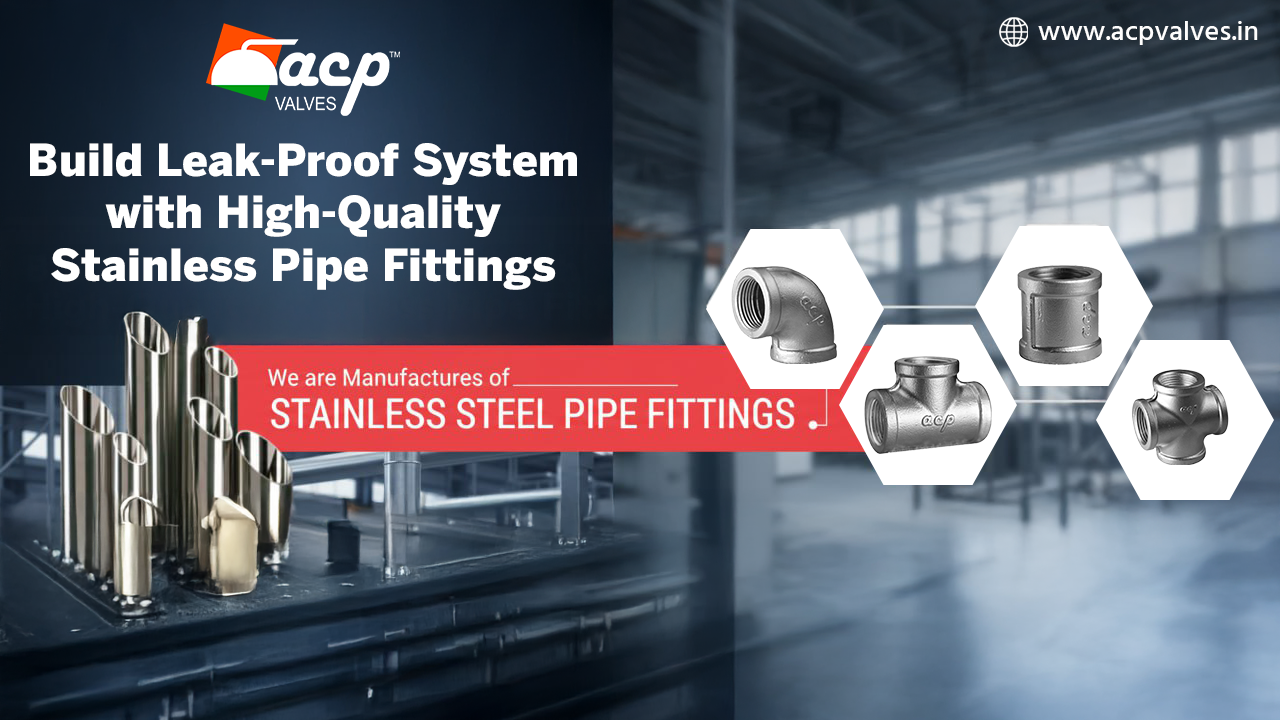
In the current infrastructure and industrial development, Stainless Steel Pipe Fittings, play an important role in ensuring safe, efficient, and leak-proof flow systems. Stainless Steel (SS) fittings are proving to be the backbone of the piping systems, carrying everything from steam and gas to corrosive chemicals.
So to ensure that your operations run with interruptions, you need high-quality SS pipes. However, as there are lots of options in the market it becomes absolutely important for you to figure out what pipe to choose. So today in this blog we’ll have a complete discussion around SS pipe fittings so that you can know its types, specifications and application.
In nutshell SS fittings are the components that are used to connect, control, or terminate the flow in a piping system. Some of the common steel pipe fittings in the market are elbows, tees, reducers, couplings, and flanges. These fittings are made from premium grades like SS 304/304L and SS 316/316L. Owing to this these fittings are known for their high corrosion resistance, mechanical strength and their ability to handle extreme temperature and pressure.
India is currently experiencing industrial expansion and infrastructure growth. Owing to this we are seeing an increase in the demand for pipe fittings manufacturers in India. High-quality SS fittings are essential in projects like oil, gas, construction and water management. They are important in ensuring safe, leak-free connections in high-pressure and corrosive conditions. This makes it a great choice for India’s refineries, petrochemical plants, and coastal operations.
As per the recent market data, India’s stainless steel fittings market is projected to grow over 4.5% CAGR in coming years. Now, this clearly shows how much industries value SS fittings for their operations
Stainless steel fittings offer several advantages over alternatives like mild steel or PVC:
There are different types of Stainless Steel Pipe Fittings that one can choose from let’s discuss what are those and their job:
These particular fittings are welded directly to the ends of the pipe, and provide seamless connections for a smooth fluid flow. As per ASME B16.9 standards, these fittings include elbows, reducers, tees and caps that range from 1/8” to 48” NB. These fittings are great for high pressure and high temperature industrial systems.
As the name suggests, these pipe fittings are manufactured through a forging process, to deliver superior strength and durability. They are usually available in socket weld and threaded types and in 3000, 6000, and 9000 lbs pressure classes.
Flanges are used to connect pipes, valves, and pumps. This allows ease in assembly and disassembly. As leading valve manufacturers in India, Acp Valves also produces flanges in multiple types such as weld neck, slip-on, and blind.
Pipe nipples are generally used to connect fittings, whereas adapters link dissimilar piping materials. They provide reliable, corrosion-resistant connections, common in high-rise buildings and industrial water lines
Tees and crosses are used to manage multi-directional flow in a system, whereas reducers are used to connect pipes with different diameters.
End caps seal pipe ends securely, while stub ends are used with lap joint flanges to reduce costs by using stainless steel only where exposed to the fluid.
Now, that you have learned different types of Stainless Steel Pipe fittings, lets have a look at the different specifications they come in
Stainless Steel fittings range from ½” to 48” Nominal Pipe Size (NPS).
Different connection methods suit specific needs:
Finishing impacts corrosion resistance and cleanliness:
Being one of the best pipe fittings manufacturers in India ACP Valves ensure compliance with:
Apart from this you will also find compliance with IS 6911 and BIS standards to meet both local and international quality benchmarks.
Quality assurance is very important for reliable fittings:
Below are the some of the reasons for why you should opt for Stainless Steel fittings:
Stainless steel is a great choice for chloride induced corrosion and even works fine in acidic or saline environments.
Even though SS fitting comes with higher initial cost, it can easily reduce long-term expenses through extended service life, often lasting up to 50 years without minimal maintenance.
SS fittings are non-porous in nature, which prevents bacterial buildup. It is great for industries who need to maintain high hygienic standards.
Stainless steel fittings can be used across wider range if industries:
Like we have told you SS fittings are great when it comes to diversity
Indian refineries, offshore rigs and pipeline networks heavily rely on SS fittings. ACP valves being leading valve manufacturers in India provide high grade fittings for every environment
Petrochemical hubs need high quality fittings for handling acids, solvents, and corrosive compounds while maintaining system integrity. Safety valve manufacturers in India have lots of different SS valves for these harsh systems.
Power plants use high-temperature grades of SS fittings such as 304H and 321. They are used in steam lines and boilers.
Many butterfly valves manufacturers in India produce high quality SS fittings with electropolished finishes for pharma and biotech industries.
Food and beverages need to adhere to high hygienic standards, so they need quality non-corrosive fittings that do not promote microbial growth.
Marine systems require SS fittings that provide resistance to seawater corrosion, for long life and low maintenance.
Ball valve suppliers in India provide high quality fittings for municipal water and sewage plants to provide corrosion and leak free performance along with easy control.
LNG terminals and transport systems in India, use high-quality fitting to transport their products across the nation without any leak and corrosion.
Stainless Steel Pipe Fittings have now become the foundation of modern industrial systems. These fittings are getting popular owing to their unmatched corrosion resistance, hygiene, and longevity. SS fitting can handle anything with ease be it oil flow in offshore rigs or ensuring sterile water in pharma and food factories.
ACP valves stands as the leading pipe fitting manufacturers in India. We have a wide range of products that include non return valve, ball valves, butterfly valves, safety valves, globe valves, and more. With precision engineering and high-quality materials we promise innovation, safety and performance with all our products.
Q1. What are stainless steel pipe fittings used for?
Ans: SS pipe fittings are used to connect, direct or terminate the flow of material in any pipeline system. It is used across a wide range of industries.
Q2. How much pressure can stainless steel fittings handle?
Ans: Steel fittings come in a wide range of variations based on the different needs. Now they can easily handle pressure up to 10,000 psi or more depending on the system.
Q3. Do stainless steel fittings need Teflon tape?
Ans: Yes, SS fittings need PTFE or Teflon tape or sealant in order to connect them with pipes and create a leak free environment.
Q4. How do you connect stainless steel fittings?
Ans: Different types of fittings are connected through different methods that include welding, threading, flanging, or compression sealing.
Q5. How to identify genuine stainless steel fittings?
Ans: You should always look for grade markings, certifications, and manufacturer’s logo to check its genuinity. You can also go for PMI testing.
Q6. Which grade of stainless steel is best for my application?
Ans: The grade of stainless steel depends on a wide range of factors such as industry, intern and extern environment and usage. It is advisable to consult a professional about this.

Copyright © 2022. All rights reserved.ACP VALVES