
Urgent Call?
+91-7453000063
Email Us
sales@acpvalves.in
+91-7453000063
sales@acpvalves.in
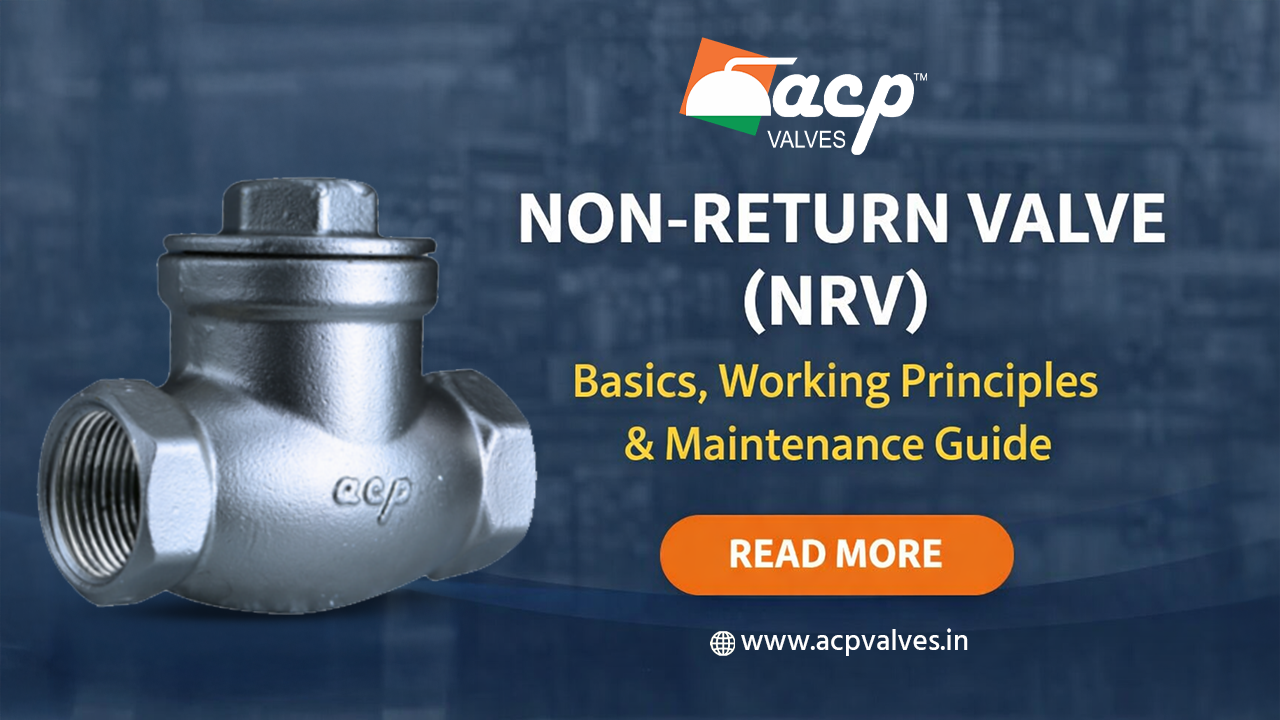
Flow control in industrial fluid systems is way more than just about getting things to move – it’s about stopping them from getting out of control. At the heart of a lot of that control is the Non-Return Valve (NRV) or, if you want to get fancy, a check valve. Whether you’re talking about a water pipeline, a chemical processing plant, some car manufacturing line, or a compressed air system, NRVs are essentially a vital part of making sure stuff runs smoothly and safely. Specifically, their job is to stop backflow from happening, keep equipment safe from all the gunk that could be coming the other way, and help keep the pressure steady. This guide will run you through the basics of non-return valves – how they work, what types there are, where they’re used, and what to do to keep them running well so they can keep your system running well for a long time.
In simple terms a non-return valve is a mechanical component that is designed to allow fluid or gas flow only in one particular direction. It automatically blocks any reverse flows, protects the pumps, pipelines and other connected equipment from any damages that can be caused by backpressure or contamination.
They are different from manually operated NRV, as the valve can respond automatically based on the pressure changes in the system.
Key functions of a non-return valve include:
NRVs are generally used in industrial systems where it is very important to have continuous and controlled flow.
Reverse flows in any industrial pipeline can lead to serious operational and financial losses. Therefore, non-return valves act as a safeguard against such risks.
If there are no NRVs, in a system even a minor pressure imbalance can lead to issues like leakage, corrosion, seal failure, or complete system breakdown.
Now that you have understood what a Non-Return valve is now let’s have a look at how it works. The valve on the principle of pressure differential. This means that the valve opens and closes automatically based on the direction and force of the fluid in the system.
This kind of automatic response makes an NRV an extremely reliable equipment when it comes to continuous industrial operations.
As per the need of the system the non-return valves are available in different designs based on the pressure range, fluid type, and installation orientation.
The first type that we would discuss is this swing type non-return valve; it uses a hinge disc that opens when the flow is in forward directions and automatically closes when the flow stops.
Key features:
They are generally used in applications like Water pipelines, HVAC systems, low-pressure industrial lines.
LIn lift type NRVs, the disc is lifted vertically when the fluid starts to flow forward and returns to its original resting place when the flow stops.
Key features:
The disc valve is generally used in steam systems and high-pressure industrial pipelines
Key features:
Last but not the least is Wafer-type and dual plate NRVs. They are highly compact in design and are generally installed between the pipe and flanges.
Key features:
These valve types are great for spaces that come with constraints and pipelines with high flow.
In order for a valve to perform better, be durable and resistant to corrosion then the Non-return Valve material is also important. The type of material used heavily based on the fluid in the system, pressure, temperature and overall environmental conditions.
Material | Suitable Applications | Key Benefit |
Cast Iron | Water systems | Cost-effective |
Stainless Steel | Chemical & food industries | Corrosion resistant |
Brass | Plumbing & low-pressure systems | Easy installation |
Alloy Steel | High-pressure pipelines | High strength |
When proper materials are combined with the surface protection and coatings, it significantly improves the life and reliability of the valve.
Non-return Valve is not a niche item, it is heavily used across various industries. As it is one of the most reliable equipment that ensures safe and efficient movement of the fluid in a system.
In each of these applications, the NRVs is used as the first line of defence in case of system failure.
Even though the valves have simple design and are highly reliable, they can develop some issues that are not maintained properly. Below we have mentioned some of the most common problems that you can face:
Common NRV problems include:
If you ignore these issues, it can lead to problems like loss of energy, decreased efficiency and increased downtime.
In order to ensure that Non-Return Valves are functioning properly for a long time it is important to conduct regular maintenance throughout their life.
Best practices for NRV maintenance:
By following this maintenance regime, you can improve life and avoid emergency repairs or system shutdowns.
Non-return valves are tiny but mighty, they can make a huge difference to keeping industrial systems running safely and efficiently by stopping backflow, keeping equipment safe, and keeping the pressure steady, which in turn helps cut down on downtime and keeps equipment running longer. But let’s be clear, it’s not just the valve itself that matters. You’ve got to pick it right in the first place, look after it regularly, and take care of the surface to make sure it lasts.
Choose the right materials, do the right maintenance, and look after it properly and you’ll end up with a system that runs smoother, costs less to run, and overall performs better.
1. What is the difference between a Non-Return Valve (NRV) and a check valve?
There is no major difference when it comes to NRV and check valve, both of these terms are used interchangeably. The job of both valves is to control the flow of fluid.
2. How do I choose the right Non-Return Valve for my system?
The choice of a Non-Return Valve depends on the factors like type of fluid in the system, operating pressure and overall temperature of the fluid.
3. How often should a Non-Return Valve be inspected or maintained?
NRVs should be maintained on a regular basis, depending on the usage intensity and the type of fluids it is transporting.


Copyright © 2022. All rights reserved.ACP VALVES