Urgent Call?
+91-7453000063
Email Us
sales@acpvalves.in
+91-7453000063
sales@acpvalves.in
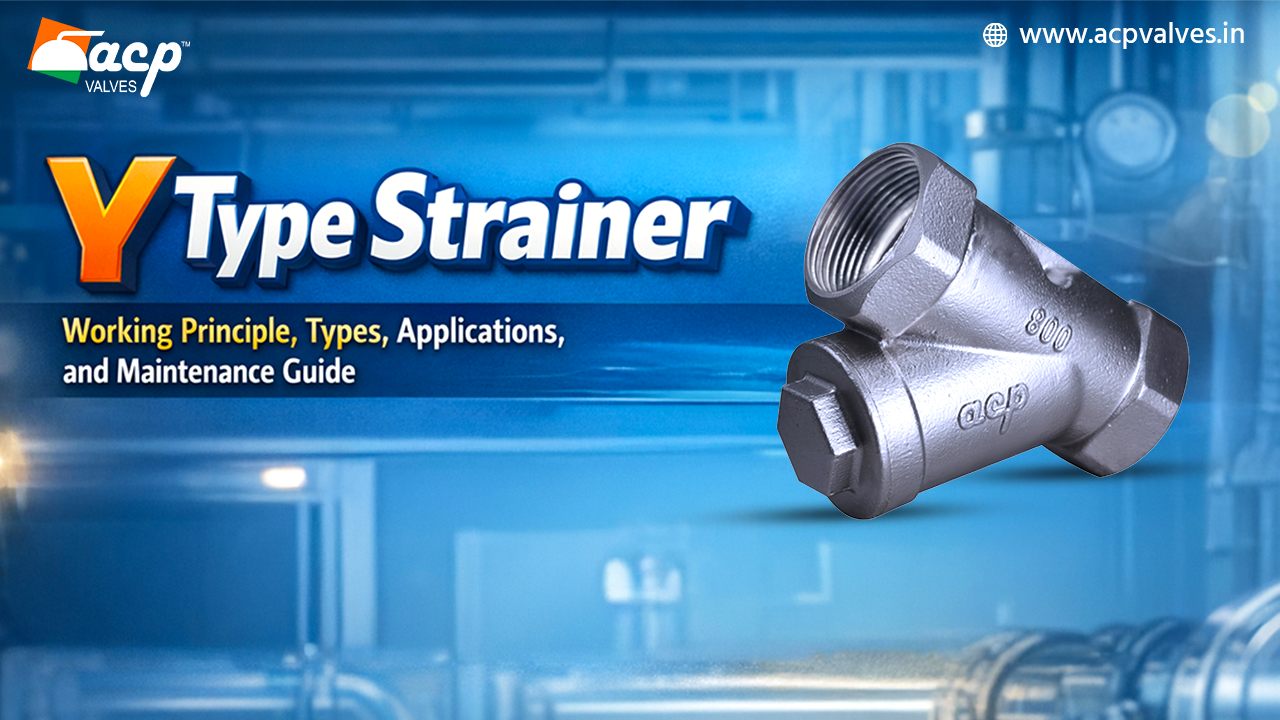
In industrial fluid systems, having an uninterrupted flow is important, for the simple reason that its safe and efficient operation is dependent on it. Even just the smallest bit of debris in a pipeline can cause a whole world of trouble, valves, pumps, meters, and even control equipment are all at risk of serious damage, which can translate to costly repairs and unplanned downtime. And it’s here that a Y Type Strainer really comes into its own.
A Y type strainer is the go to pipeline filter, for most of us in the know – its job is to catch unwanted solid particles in liquids, gases, or steam before they get to the sensitive equipment that relies on them. In this blog we’ll take a look at what a Y type strainer actually is, and how it works, plus we’ll cover its types, applications, benefits & maintenance practices – all in one handy guide that should help you choose the right strainer for your industrial use needs.
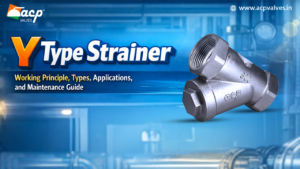
A Y type strainer it’s a pretty straightforward piece of kit, if you think about it. It’s a kind of mechanical filter that gets plugged into a pipeline where it catches any loose debris or other unwanted junk that might be floating around in the media. Its ‘Y’ shape comes from the way it’s designed – you got a main body with a bit of a Y shape to it & inside that’s a screen, either perforated or a proper mesh job. The idea here is that it keeps the junk from gumming up the works downstream. Think about all the equipment that relies on the smooth flow of media, control valves, pumps, compressors, heat exchangers and flow meters, for instance. These are all going to get mucked up pretty quickly if you let debris and whatnot into the mix.
Core functions of a Y type strainer:
Y strainers are commonly used in water, oil, gas, steam, and chemical pipelines across industries.
Industrial pipelines often carry fluids that contain scale, welding slag, rust, or sediment. If these contaminants are allowed to pass freely, they can cause abrasion, clogging, leakage, or complete equipment failure.
In systems where uptime and safety are critical, installing a Y strainer is a simple but essential preventive measure.
The working principle of a Y type strainer is straightforward and effective.
Many Y strainers are equipped with a drain plug or blow-off valve to simplify cleaning without removing the strainer from the pipeline.
Understanding the components of a Y type strainer helps in selecting, installing, and maintaining it correctly.
Each component must be selected based on pressure, temperature, and fluid compatibility.
Y type strainers are classified based on material, design, and connection type, depending on application requirements.
Cast iron Y strainers are economical and widely used for low-pressure applications.
Typical uses
Advantages
Carbon steel Y strainers offer higher strength and pressure-handling capability.
Typical uses
Advantages
Stainless steel Y strainers provide excellent corrosion resistance and hygiene.
Typical uses
Advantages
Connection Type | Best Suited For |
Flanged Y Strainer | Medium to large pipelines, high pressure |
Threaded Y Strainer | Small pipelines, low pressure |
Selecting the correct connection type ensures safe installation and easy maintenance.
Y type strainers are used across a wide range of industries to protect critical equipment.
In each case, the strainer ensures clean flow and reduced equipment wear.
Y type strainers offer multiple operational and economic benefits.
These benefits make Y strainers a preferred choice for continuous industrial operations.
Choosing between a Y strainer and a basket strainer depends on flow rate, space, and maintenance needs.
Feature | Y Type Strainer | Basket Strainer |
Space requirement | Low | High |
Flow capacity | Medium | High |
Maintenance | Simple | More frequent |
Installation | Inline | Usually vertical |
Y strainers are ideal where space is limited and continuous flow is required.
Regular maintenance ensures reliable strainer performance and prevents pressure drop issues.
Preventive cleaning intervals depend on fluid cleanliness and operating conditions.
Selecting the correct Y strainer is essential for long-term system reliability.
A well-selected strainer minimises pressure loss and maintenance costs.
ACP Valves designs Y type strainers for industrial-grade performance and long service life. Their strainers are engineered to handle demanding operating conditions while maintaining efficient filtration.
ACP Valves focuses on reliability, safety, and lifecycle efficiency, making their Y strainers suitable for critical applications.
What mesh size is best for a Y type strainer?
Mesh size depends on fluid type and downstream equipment sensitivity.
Can Y strainers be used in steam lines?
Yes, carbon steel or stainless-steel Y strainers are commonly used in steam systems.
How often should Y type strainers be cleaned?
Cleaning frequency depends on contamination level; routine inspection is recommended.
What is the difference between a Y strainer and a basket strainer?
Y strainers are compact and suitable for continuous flow, while basket strainers handle higher flow rates.
Do Y strainers cause pressure drop?
A minor pressure drop occurs, but correct sizing minimises its impact.
A Y-Type Strainer is a tiny but seriously important gizmo in industrial gear, the kind of thing that can all too easily be overlooked until something goes horribly wrong. By stopping junk from reaching sensitive equipment, it keeps the whole shebang running smoothly, saves you from the hassle of downtime, and helps your fancy equipment last longer. Choosing the right strainer for the job, giving it a bit of TLC on a regular basis, and stopping corrosion in its tracks are the key to making it work as it should for years to come. And with ACP Valves specially designed Y-Type Strainers you can bank on clear flow, reliable action, and lower costs in the long run.

Copyright © 2022. All rights reserved.ACP VALVES